
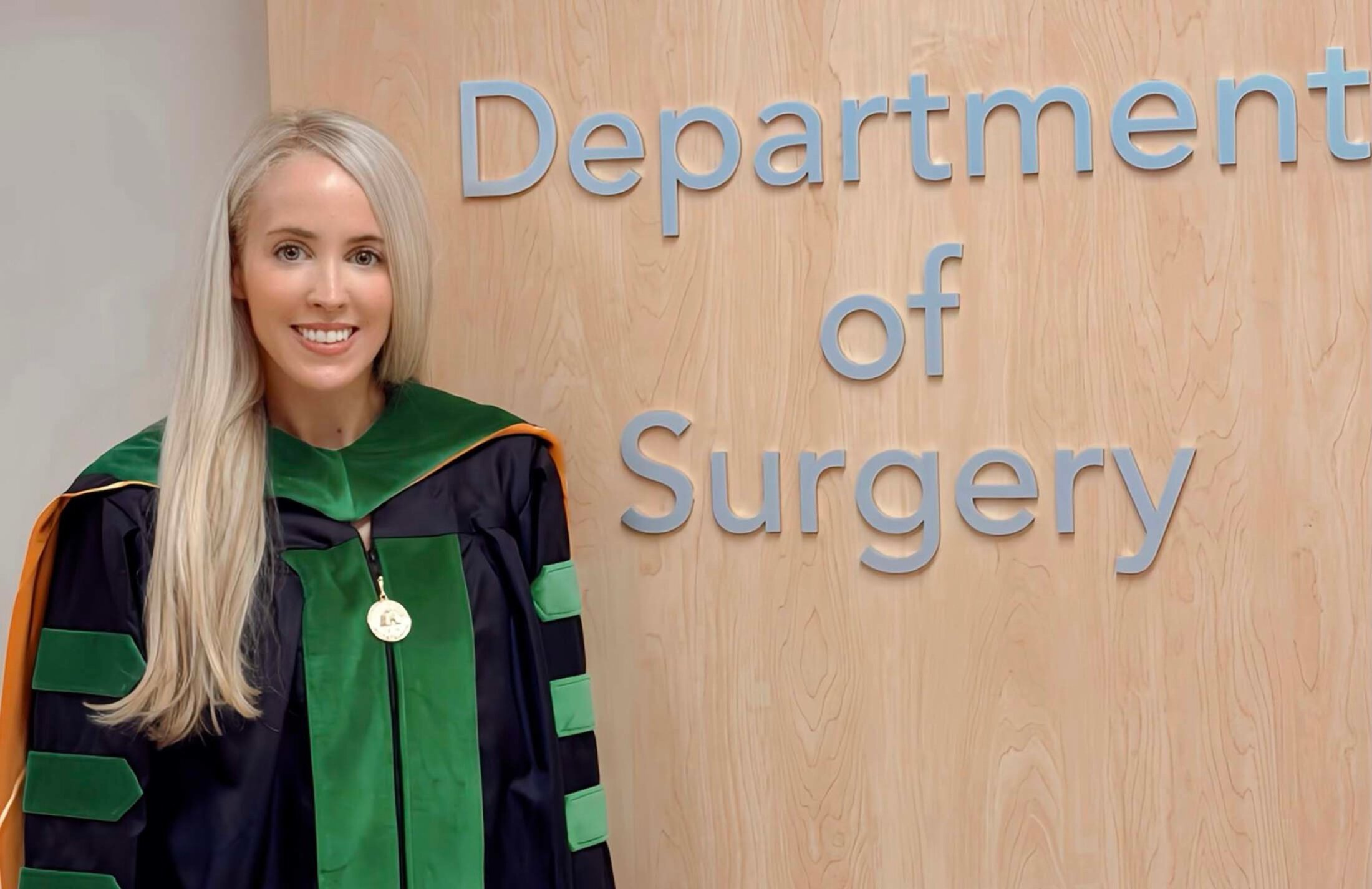
Melissa Lamicq is stepping into one of the most competitive residency pathways in medicine: integrated cardiothoracic surgery. Her path to this moment has been anything but conventional. Unlike some of her classmates, she hadn’t always planned to become a doctor.
A first-generation college graduate and mother of two young daughters, now ages 9 and 11, Lamicq completed a master’s degree in medical sciences and spent years working full-time in clinical research focused on heart failure.
The turning point for Lamicq came not in a classroom but in two hospital rooms: first, during the difficult delivery of her first daughter by cesarean section. And years later, the birth of her second daughter at MUSC would reshape everything.
“The trust, belief and empowerment my obstetrician imparted in me when I did my second birth is what initially drew me to medicine.”
Bedside care beginnings
Her premedical schoolwork as a patient care technician, working closely with individuals living with advanced heart failure, placed her directly at the bedside of patients.
“I had physically watched patients pass from this disease and watched their families cope with that,” she said.
Later transitioning into clinical research, she coordinated trials focused on therapies to treat and manage heart failure, which offered her a view into how new therapies are developed and tested.
A mature passion
While many med students begin their training exploring different specialties, Lamicq arrived with a level of clarity that is relatively uncommon.
Two forces shaped her certainty. On one hand were the patients she had cared for as a patient care technician, grounding the disease in lived experience. On the other hand, her work in clinical research involved seeing firsthand emerging therapies and clinical trials.
Those experiences created what she describes as a “very mature” passion, one rooted in a clear understanding of both the limitations and potential of medicine.
Mother and student
Lamicq’s transition to medical school came on top of an already full life. The year before she matriculated, she worked full-time while completing her master’s degree. When she began medical school, her youngest daughter started kindergarten that same year.
“There was not a whole lot of sleep sometimes,” she said.
What made it sustainable was adaptation. She became, in her words, “extraordinarily efficient.” The habits and discipline she developed during her clinical years carried over into her approach to navigating medical school.

She often mentally returned to the patients she had cared for, particularly those whose conditions she had watched worsen over time – and those who had not survived. Seeing patients as individuals became a throughline in how she approached her education and how she hopes to practice medicine.
At home, her daughters were growing up alongside her medical training, and that awareness carried weight for her.
“I didn’t have an example of what I was doing right now,” she said. “But they did.”
Clarity into specialty
Earning her residency spot in integrated cardiothoracic surgery required not only strong academic performance but a commitment to the field and a clear sense of purpose, something she had been building for years.
“There are actually not many spots in the United States, and I am very grateful that I was given the opportunity to pursue this field and contribute to it.”
The specialty aligns directly with what first drew her to medicine, with both the scientific and emotional foundations she values. Cardiothoracic surgery offers the opportunity to intervene at critical moments and, in some cases, extend life.
“I genuinely love cardiac surgery,” she said.
A future of integration
At the heart of Lamicq’s vision of herself as a physician is compassion. In cardiothoracic surgery, she is aware of how easily emotional distance can develop as a protective mechanism. For her, that is something to guard against.
“I hope to be compassionate,” she said, acknowledging how physicians can become fatigued or emotionally dulled over time. “It’s very easy not to experience the full depth of emotion that a patient may often need.”
Preserving a sense of human connection is central to the kind of physician she plans to become. That same perspective shapes how she envisions her career. Rather than choosing between clinical practice and research, she sees them as interconnected parts of the same path. As a surgeon, she plans to remain engaged in research, continuing work that connects patient care to new therapies.
Now, as she approaches graduation and her next chapter, she is focused on possibility.
She hopes that those who may be considering a similar route, especially those navigating nontraditional circumstances, can learn from her experience. “I think that many of us limit our own ability based on our perceptions of what we’re capable of,” she said.
“If you believe that the opportunities are truly limitless, you can achieve anything, and your circumstances should never dictate your own potential.”

Jennifer Sweenie
Recent MUSC News stories