

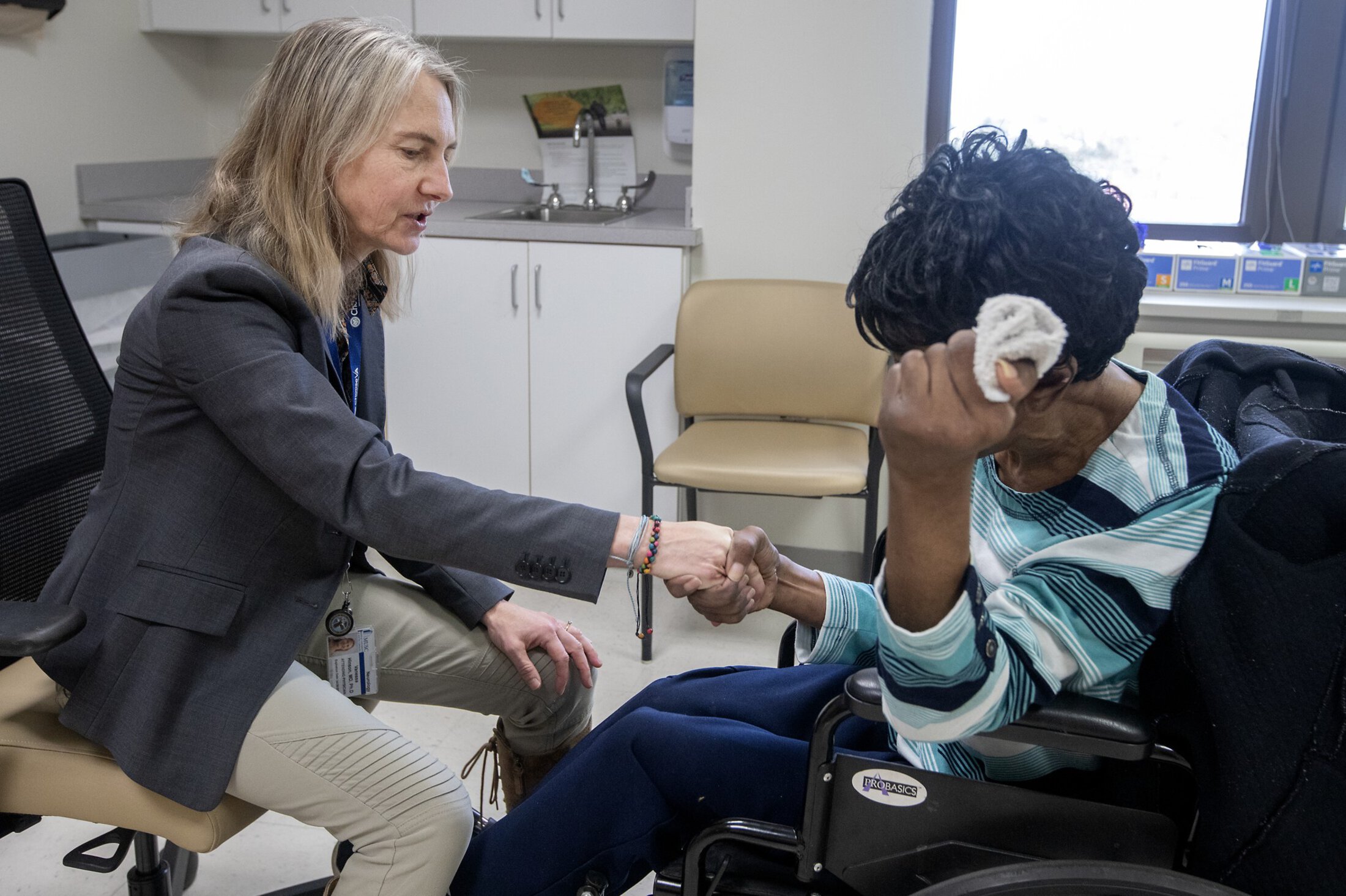
For all of the research that has been done on Parkinson’s disease (PD), very little has focused on how it affects Black people. A 2023 study published in Movement Disorders reported that while Black Americans make up 13.6% of the U.S. population, only 2.1% of participants enrolled in PD trials are Black. Other studies cite that number even lower – at 1.7%.
Without genetic data specific to minorities, it’s impossible to tailor precision treatments for the disease, said Vanessa Hinson, M.D., Ph.D., professor of neurology and director of the Movement Disorders Program at the Medical University of South Carolina (MUSC).
Hinson is a neurologist who specializes in movement disorders and serves as the principal investigator for the Black and African American Connections to Parkinson's Disease (BLAAC PD) study at MUSC, which was selected as a study site. BLAAC PD is part of the Global Parkinson’s Genetics Program (GP2), which is working to improve understanding of the genetic architecture of PD and make this knowledge globally relevant and accessible. GP2 is supported by the Aligning Science Across Parkinson's (ASAP) initiative and implemented by The Michael J. Fox Foundation for Parkinson’s Research.
“While African Americans and Black people are at a risk of Parkinson’s disease that's really similar to anybody else in the world, they've been largely left out of Parkinson’s research. Most of what we know about Parkinson's, and especially the genetics of Parkinson's, is derived from White populations,” said Hinson.
"Most of what we know about Parkinson's, and especially the genetics of Parkinson's, is derived from White populations.
BLAAC PD
BLAAC PD investigators collect blood or saliva samples and medical histories from Black people with and without PD. These samples are genetically tested, and the data sets are added to results from other studies around the world. Participation can be completed in a single visit, and the study covers travel expenses for interested participants.
“Molecular subtyping using genetic data can help predict the likelihood of PD complications such as falls, dementia or psychosis. In some cases, it can aid in the choice of the best therapy for the patient, or help with the question whether they should be undergoing deep-brain stimulation for Parkinson's. That additional information about someone's Parkinson's genetics can really guide prognosis and treatment, which are huge things,” said Hinson.
“We've entered an era where we’re trying to characterize what subtype of Parkinson's an individual has so that we can give people better access to more individualized information,” she continued.
One example of that progress came in 2023, when GP2 scientists identified a gene change in some people of African descent with Parkinson’s disease. Participants in BLAAC PD also have the opportunity to participate in another genetic PD study. This study offers patients the opportunity to include genetic data in their medical records and meet with genetic counselors to discuss what the results mean.
“If you don't know what gene you have, you don't know if you could participate in a trial that could potentially modify the course of your Parkinson's. We're losing out on a lot of opportunities if we don’t gene test our patients,” said Hinson.
Ensuring trust
In 2015, Phil Gee, an African American currently living in Clarksville, Virginia, was diagnosed with Parkinson’s disease after a battery of tests. At the time of diagnosis, he had recently retired with plans of traveling the world with his wife Julia. Gee thinks that a lack of awareness of the disease contributed to his difficulty finding effective treatment for his condition. In response, he set out to understand his condition more fully and to build awareness and trust in communities that have historically been underrepresented in research.
There is a well-documented history of mistrust between Black communities and medical research, particularly in the South. One of the most widely cited examples is the U.S. Public Health Service (USPHS) Untreated Syphilis Study at Tuskegee, conducted from 1932 to 1972 in Macon County, Alabama. In this study, investigators withheld treatment from participants with syphilis to observe the progression of the disease.

Gee noted that apprehension about participating in medical research is common among Black people, who worry about being treated like guinea pigs in experiments, remembering the USPHS study, among others.
“I'm a research advocate – both with the Parkinson's Foundation and BLAAC PD,” said Gee. “We understand that there are safeguards in place today to deal with some of the issues we dealt with in the past. So now, it's a matter of education and communication.”
He and his wife, Julia Gee, advocate for BLAAC PD and work hard to engage others in the BLAAC-PD study.
"Everyone has a role and responsibility to play in research,” he said.
Hinson is highly sympathetic to such concerns and reiterates the importance of safeguards when protecting clinical information.
“Once we collect the data, we de-identify it,” she explained. “That means that when a patient gives a blood sample, his or her name is completely removed and a very long number is assigned to it. Therefore, the only information that goes along with the blood sample is just a number code.”Hinson is grateful for the support the Gees and other prominent members of the Black community have offered.“
A community ambassador can make a huge difference. And we need more people like Phil and Julia who spread that word and encourage others to go seek help.”
People who are interested in participating in BLAA P can contact Hinson's group via email: movementresearch@musc.edu.


Vanessa Hinson, M.D., Ph.D.
- Movement Disorders
- Neurology
- Charleston, SC
- Mount Pleasant, SC

Naveed Saleh
Recent MUSC News stories