
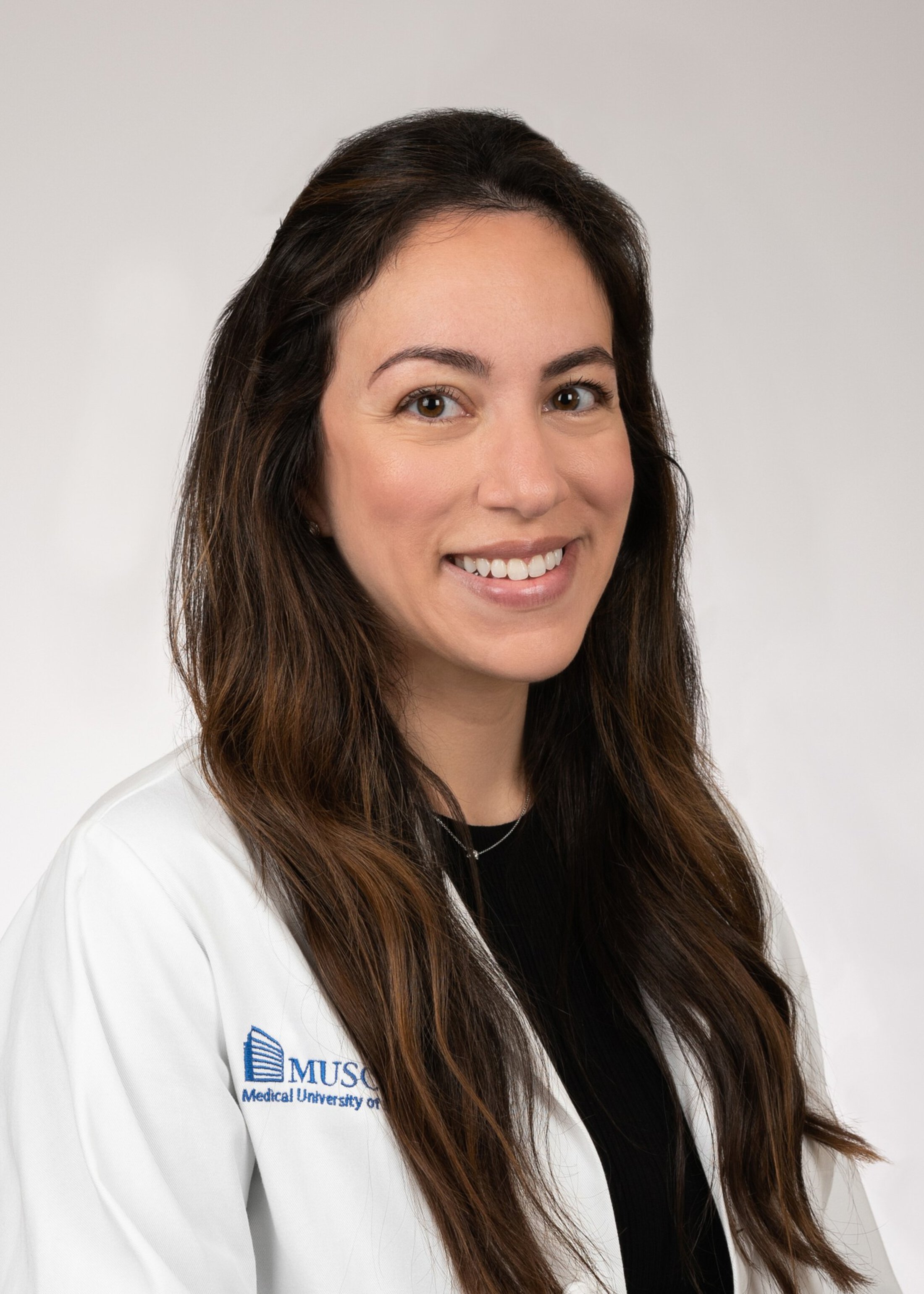
Michele Esposito, M.D., an interventional-heart failure cardiologist and assistant professor of medicine at the Medical University of South Carolina (MUSC), has received a prestigious Mentored Patient-Oriented Research Career Development Award, also known as a K23, from the National Heart, Lung, and Blood Institute of the National Institutes of Health.
Career Development Awards help early career clinician-scientists transition into independent investigators by providing funds to directly support their work while also protecting time for research activities. The award will give her more time in the lab to pursue an innovative approach aimed at restoring functional activity and quality of life for patients with heart failure.
Esposito focuses her research on the mechanisms underlying peripheral microvascular dysfunction in heart failure. She explains that exercise intolerance is one of the most significant manifestations of the condition and is strongly linked to hospital admissions and mortality. Yet traditional cardiac measures do not fully explain why some patients are so functionally limited. While clinicians often focus on cardiac function in heart failure, her work highlights the importance of peripheral mechanisms, including skeletal muscle and vascular dysfunction, as targets for improving exercise tolerance.
Currently, neither the American College of Cardiology nor the American Heart Association recommends routine testing of peripheral skeletal muscle in heart failure patients. As a result, this aspect of the condition often goes unassessed, leaving a gap in understanding for patients who struggle with performing even basic daily activities. Her study aims to help close that gap.
The K23 award will allow Esposito to dedicate 50 percent of her time to her study, “Regional Disparity of Skeletal Muscle Microvascular Dysfunction in Systolic Heart Failure.” The project builds on the South Carolina Clinical & Translational Research (SCTR) K12 Award she received in 2024, which generated preliminary data supporting her NIH application. SCTR, an NIH-funded statewide organization housed at MUSC, works to accelerate research from the laboratory to patient care.
The collaboration with these colleagues has been instrumental in developing the program and exploring new aims that may yield benefit to patients in the future.
Esposito credits her K12 mentors, Michael Zile, M.D., and Amy Bradshaw, Ph.D., for their support. “The collaboration with these colleagues has been instrumental in developing the program and exploring new aims that may yield benefit to patients in the future,” she said.
“Supporting rising physician-scientists has been a cornerstone of my career,” Zile said. “A strong mentor-mentee relationship is critical to the development of junior faculty members like Dr. Esposito, and this K23 Award is a valuable next step on her pathway to research independence.”
She also partnered with Antony Gayed, M.D., and Ricardo Yamada, M.D., in interventional radiology at MUSC, to help build the skeletal muscle biopsy program essential to her research. She emphasized the importance of MUSC’s strong clinical and research infrastructure, under the leadership of Ryan Tedford, M.D., Section Chief of Heart Failure, in accelerating her work.
Esposito said she is honored to receive the award and emphasized that it is critical for junior faculty to learn research methodology early in their careers. “Clinical demands, especially as a cardiology proceduralist, can be significant, and clinician-scientists often struggle to find time not only to conduct research but to learn from their mentors. I feel very fortunate to have the support of my mentors and the endorsement of the Department of Medicine at MUSC, where clinical investigation is highly valued.”

Michele Esposito, M.D.
- Interventional Cardiology
- Cardiology
- Charleston, SC

Lauren Hooker
Recent MUSC News stories