
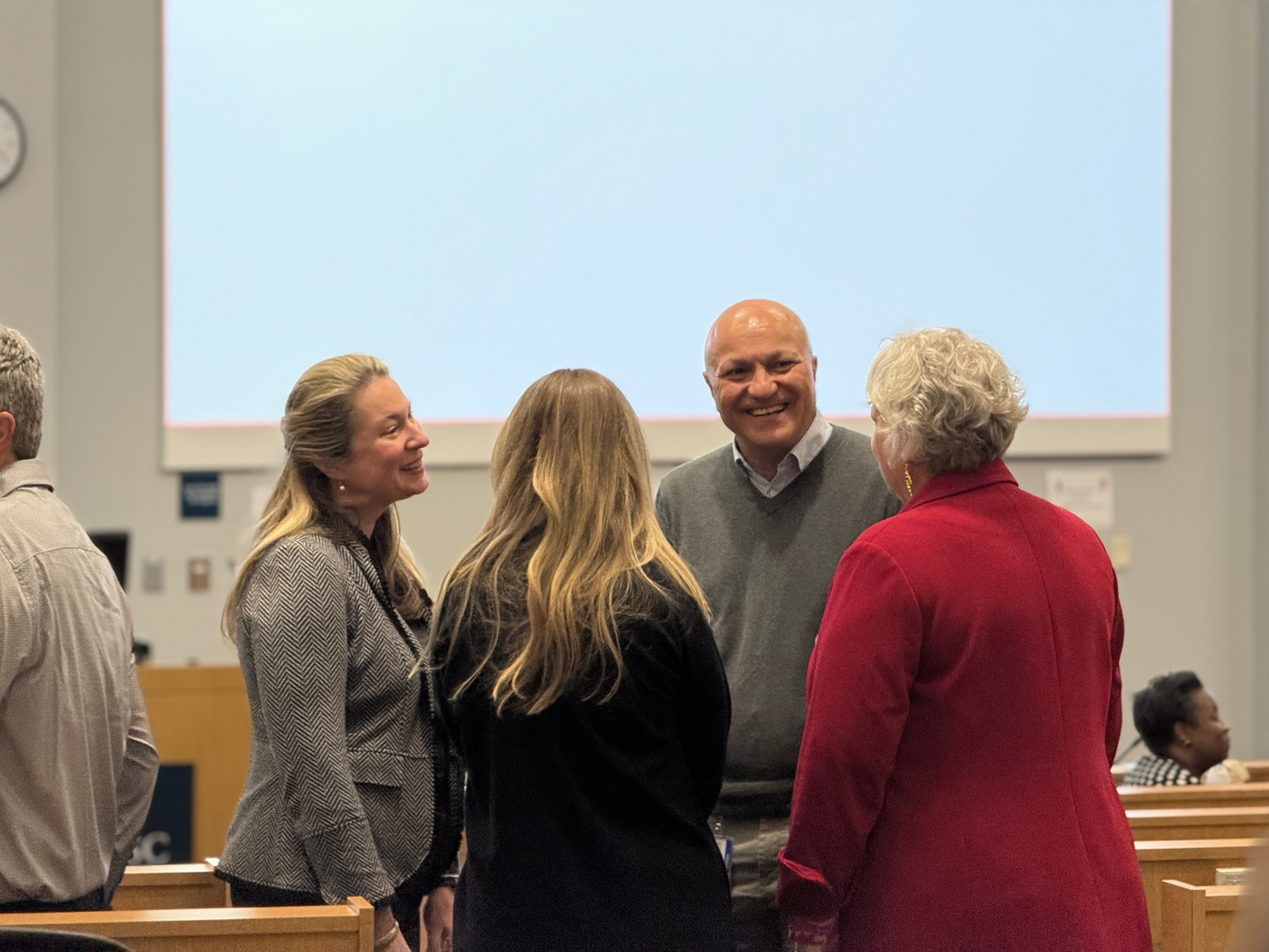
On the first Monday of March, members from across MUSC’s enterprise gathered to hear from research leaders about the state’s scientific trajectory, with a particular emphasis on artificial intelligence (AI) initiatives. Hosted by the Office of the Vice President for Research (OVPR), the MUSC EPSCoR and AI Integration Symposium welcomed Nadim Aziz, Ph.D., director of the South Carolina Established Program to Stimulate Competitive Research (SC EPSCoR), to explore the growing synergy between EPSCoR’s statewide mission and MUSC’s rapidly evolving AI strategy.
From the outset, the message was clear: South Carolina stands on the brink of significant research advancement, and the partnership between EPSCoR and MUSC’s AI ecosystem will be central to its success.
MUSC’s success with EPSCoR funding opportunities
Timothy Stemmler, Ph.D., vice president for research at MUSC, opened the event and shared the history of the National Science Foundation (NSF) EPSCoR program, established in 1979 to support states that had been historically underfunded in federal research and development. He noted that this program paved the way for similar federal initiatives, such as the Centers of Biomedical Research Excellence (COBRE) program, funded by the National Institutes of Health’s National Institute of General Medical Sciences (NIGMS). Today, MUSC leads the nation in COBRE funding, with more than $159 million awarded across current and prior programs.Stemmler went on to emphasize the importance of leveraging these opportunities to strengthen MUSC’s research capacity, recruit outstanding faculty, train emerging scientists and advance health care innovation in South Carolina.
Following his remarks, Carla Stipe, director of the Office of Research Development, provided an overview of anticipated funding opportunities and highlighted the importance of staying connected through MUSC research communication channels. She emphasized the hard work of the OVPR and its divisions in keeping investigators informed of timely opportunities and evolving funding mechanisms.
SC EPSCoR’s mission: expanding research capacity across South Carolina
Aziz shared the core directive of the SC EPSCoR program: strengthening the state’s capabilities by building infrastructure, supporting scientific talent and enabling collaborative innovation. South Carolina currently receives just 0.68% of all NSF funding, which is below the 0.75% threshold that qualifies states for EPSCoR support, positioning it well to continue benefiting from EPSCoR programs designed to elevate research competitiveness.A centerpiece of that growth is the state’s updated Vision 2030 Science and Technology Plan, which focuses on expanding high-tech industry, accelerating innovative entrepreneurship, deepening STEM education pathways and enhancing research excellence at the state’s universities. Through this plan, SC EPSCoR deploys several different funding streams to support the current NSF EPSCoR Research Improvement Track-1 award, ADAPT in SC, which is helping to drive a statewide transformation in AI-enabled biomedical devices.
ADAPT in SC: Accelerating AI-enabled biomedical devices
ADAPT in SC, which stands for AI-enabled Devices for the Advancement of Personalized and Transformative Healthcare in South Carolina, focuses on developing AI-enabled biomedical devices – not AI for its own sake, nor medical devices in isolation, but intelligent technologies that can sense, learn and guide research and clinical decision-making.
MUSC investigators involved in current projects include Jihad Obeid, M.D.; Jesse Dean, Ph.D.; G. Hamilton Baker, M.D.; Grant Goodrich, Ph.D., and Jean Marie Ruddy, M.D. ADAPT in SC spans nine funded research initiatives from various state universities, ranging from explainable AI diagnostics to deep learning-driven rehabilitation tools.
ADAPT in SC’s research initiatives include:
- XAI-enabled diagnostic and planning devices.
- Biomedical devices for personalized prognostics and treatment.
- AI-driven rehabilitation and therapeutic systems.
The initiative has already supported five new faculty hires statewide, with recruitment underway at MUSC for a faculty member specializing in biomedical data curation. It also offers a collaborative pathway for investigators who need AI expertise to become competitive applicants.
AI at MUSC: Building the infrastructure for the future
While SC EPSCoR is building the statewide research scaffolding, MUSC is rapidly constructing its own technological core.
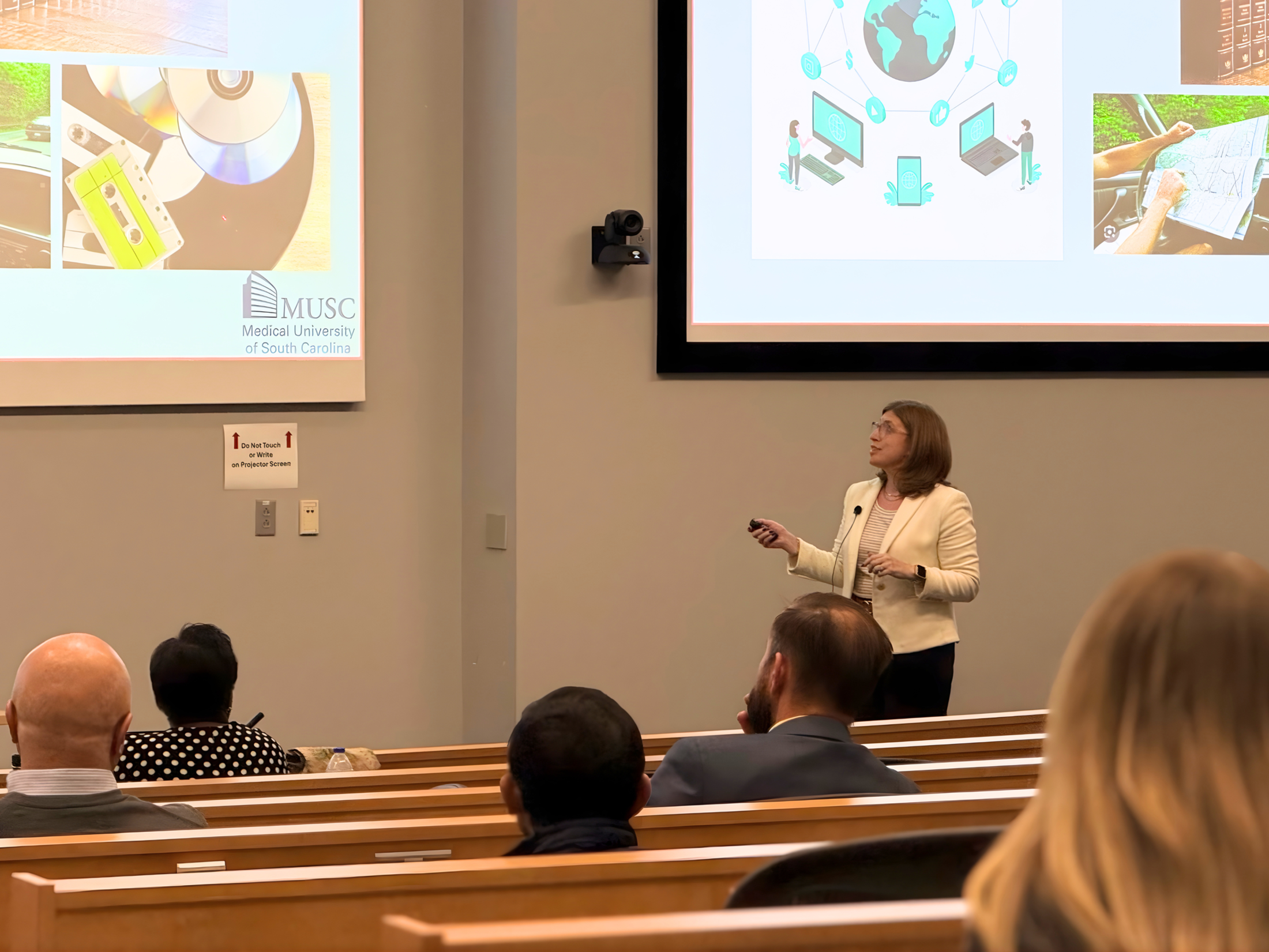
Presenting at the symposium, Marylyn Ritchie, Ph.D., chief artificial intelligence officer, outlined how AI has powered her own research, from disease subtyping and electronic health record (EHR)-based phenotyping to multi-omic integration and prediction of disease trajectories. With MUSC’s EHR dataset spanning back to 2012 and enriched by geospatial and environmental data, Ritchie said the opportunities for AI-powered breakthroughs are extraordinary.
Launched to support OneMUSC’s strategic vision, Ritchie’s AI Center for Health Innovation and Informatics aims to:
- Pioneer AI-driven health care delivery, research and education.
- Build a competent AI-ready workforce.
- Support ethical, transparent and secure use of AI.
- Develop prototypes and tools to empower investigators.
- Strengthen partnerships with other research institutions.
An AI governance framework is nearing its launch at MUSC, ensuring that AI development remains responsible, safe and aligned with patient and public trust.
Future funding opportunities in AI and biomedical research
Obeid expanded the conversation, highlighting upcoming grant opportunities in which AI may play a central role, including:
- EPSCoR Research Incubators for STEM Excellence (E-RISE).
- The Duke Endowment grants in the field of health care, with current funding priorities in several areas that include population health, oral health and mental health.
Other upcoming funding streams mentioned included the South Carolina Clinical and Translational Research Institute's pilot programs, collaborative grants with the University of Florida (UF) through the MUSC-UF Southeastern Health AI Consortium and forthcoming AI Center pilot grants.
Obeid invited audience members to take advantage of the Clemson-MUSC AI Hub for consultations. He also encouraged investigators to utilize the services of the Hub and the Office of Research Development to find collaborators that align with EPSCoR priorities, identify funding opportunities in AI, and build competitive proposals.
A united statewide vision
As the symposium came to a close, a shared sentiment emerged: South Carolina is entering a pivotal era. Tthe SC EPSCoR program is supplying the infrastructure, vision and funding mechanisms needed to elevate the state’s scientific impact. MUSC is building the technological and workforce foundations to be a leader in AI-driven health care innovation. Together, they are creating a multitude of opportunities for researchers at every stage – from trainees to established investigators – to pursue bold, interdisciplinary science that will improve lives across the state for years to come.
Allison Olawsky
Director, Research Communications, Office of the Vice President for Research
Recent MUSC News stories