
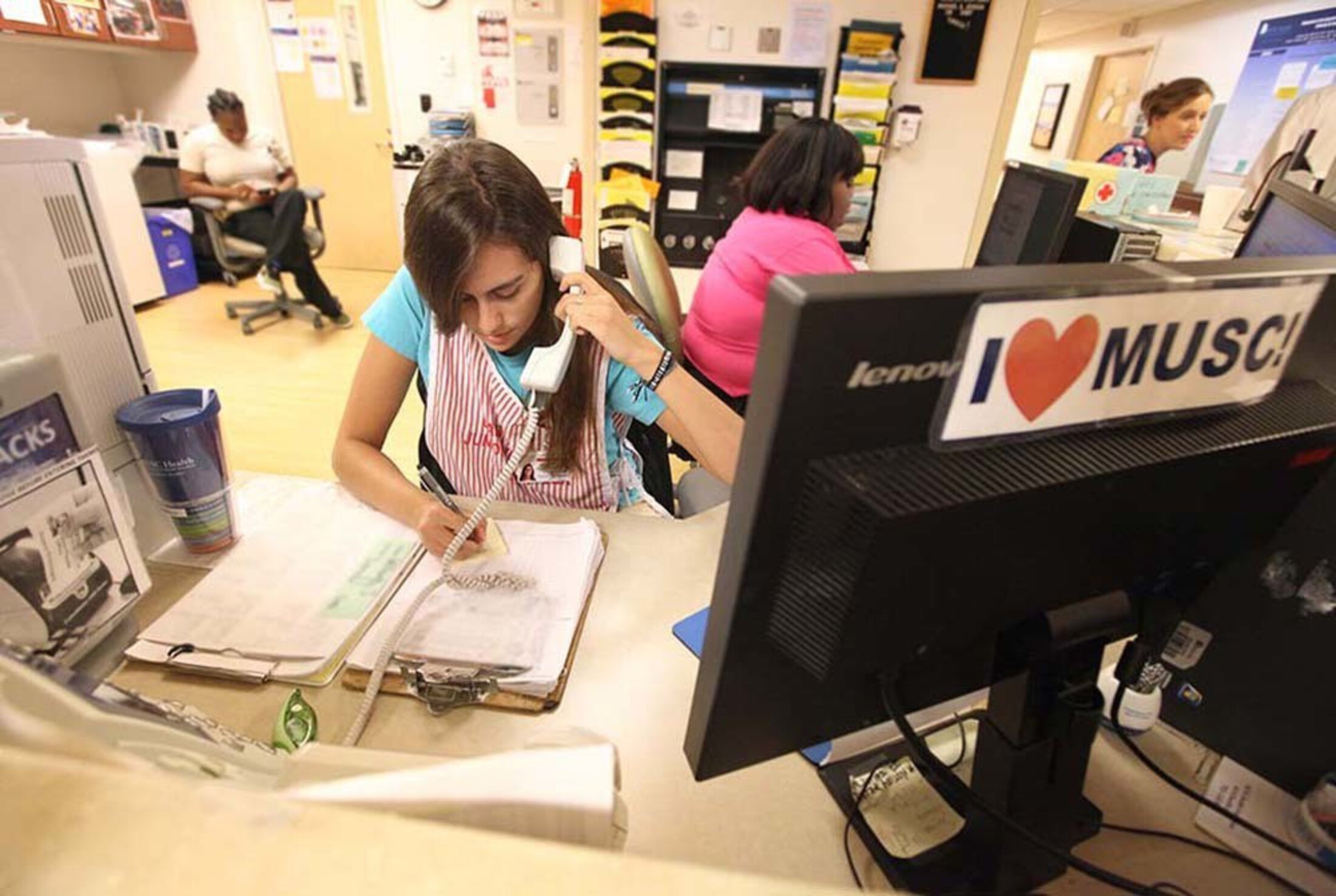
It's something seen in very few hospitals around the country nowadays – the red and white pinafore of the candy striper. But walk the halls of MUSC during the summer, and you’re bound to spot a pinafore-clad teen, delivering supplies, helping visitors navigate the maze of buildings, bringing water to patients, answering phones or pushing the ever-popular courtesy cart with coffee and snacks for staff and patients’ family members.
While most hospitals have started calling teens “junior volunteers” and placing them on a once-per-week schedule similar to adult volunteers, MUSC continues to operate its summer candy striper program. Teens ages 14 to 18 commit to working 8 a.m. to 4 p.m. for three weeks and have the opportunity to see how all the departments, clinical and non-clinical, contribute to making the hospital run.
“As an academic medical center, we really feel it’s our mission to provide this type of program to the community,” said Kelly Hedges, program manager for volunteer services.
Most of the teen volunteers are interested in health care as a career, and some find new interests during the program as they discover the various career fields within the hospital.
“I like to see the change of their perception of what they think health care is and what it actually is,” said Melissa Kubu, the program coordinator who oversees the candy stripers. “They get to see how much it takes to run a hospital and the collaboration that it takes for that to happen. They get to see the diversity in what an organization this big offers.”
Adelaide Brady, 16, is one of this year’s candy stripers. The rising School of the Arts junior was a patient at another hospital when she was younger, so she knows the feeling of being hospitalized and wants to give back to others now. One of the fascinating things about her summer has been seeing a hospital from the other side, she explained.
“I’m having a lot of fun,” she said.
Each candy striper has regular morning and afternoon assignments. Adelaide helps with administrative work in neurology in the morning, where she gets to see what the residents do and how their days are structured. She’s interested in neurology as a career herself.
In the afternoons, she moves to the sixth floor of Ashley River Tower, where she helps the nurses and answers patients’ call bells.
Sixty-seven teens applied for the program this year, and 32 were accepted. They have to provide proof of their GPAs as well as recommendation letters, then go through an interview process, Kubu said. For many, it’s their first time interviewing for anything. Though candy striping is volunteer work, it’s very much a job, Kubu said, and the teens learn people skills and professionalism. Both boys and girls can be part of the program.
Catalina Roa, 17, is a rising senior at Wando High School. She’s always liked medicine, she said. She watches doctor shows with her mom, looks at surgery videos on YouTube and has taken medical classes at Wando. She wants to be a trauma surgeon, although she’s also interested in orthopedics.
She found out about the candy striper program by looking for volunteer opportunities on MUSC’s website and realized it would be a great opportunity to get a feel for the hospital environment and give back to the community.
She spends her mornings in the Child Life Atrium at MUSC Children’s Health and her afternoons at the main hospital on the orthopedic unit, where she restocks supplies, walks with patients, answers the phone and brings ice water to patients.
She enjoyed it so much that only two weeks into her summer commitment, she had arranged to become a year-round volunteer.
“Now I can get into the hospital all year round, which to me is fun. I love being in the hospital,” she said.
Besides their regular work assignments, the candy stripers also get enrichment activities. This year they’ve taken a tour of the MUSC Shawn Jenkins Children’s Hospital, which is under construction, and toured Meducare operations, including riding in an ambulance and visiting a helicopter.
Kubu said she loves to hear the teens’ stories at the end of each shift, whether it’s about watching how a nurse communicates with a patient or how grateful a family member was for being escorted from one building to the next.
“My favorite part of the kids being here is their enthusiasm,” Hedges said.
Hedges and Kubu said seeing the young volunteers is nostalgic for many patients, some of whom will share that they were candy stripers, too.
“It creates talking points just from the red and white pinafore. The red and white pinafore is iconic. And it creates a memory that’s a pleasant memory in a place that might not be pleasant,” Hedges said.

Leslie Cantu
Senior Communications Manager
Leslie Cantu is the senior communications manager at MUSC Hollings Cancer Center, where she works with researchers, clinicians and patients to tell the people of South Carolina about the innovative work being done to improve cancer care for everyone in the state. She joined the MUSC Office of Communications and Marketing in 2018 after a career as an award-winning writer, editor and producer at community newspapers and local TV news. She transferred to the communications office at Hollings in 2022, where she happily finds something new and interesting to write about every day. Her favorite stories to cover at MUSC have included Match Day, the Angel Tree Parade, a clinical trial of CAR-T cell therapy and the many patients who have agreed to share their very personal struggles and triumphs.