
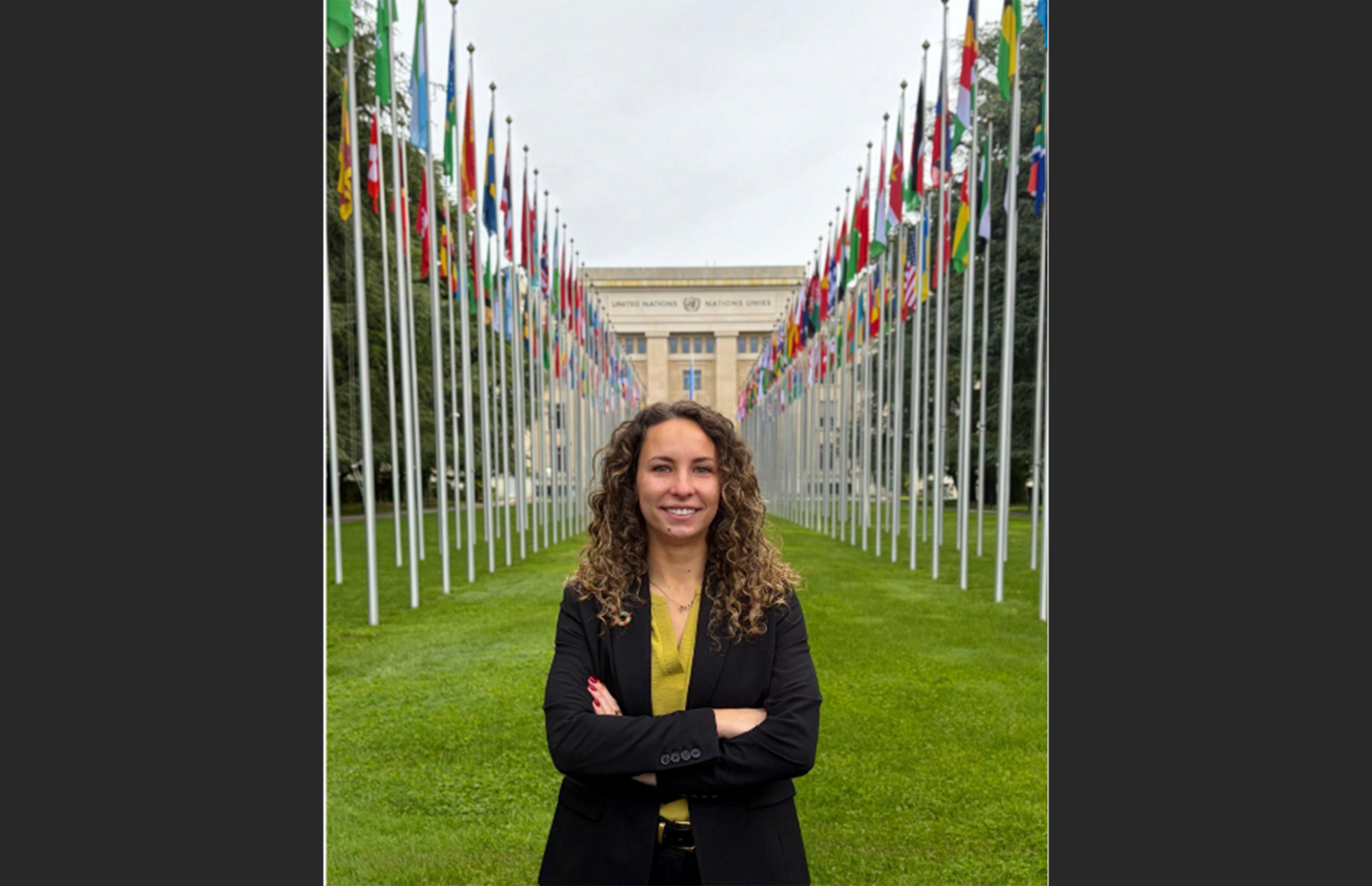
Recently, thousands of clinicians, policymakers, advocates and health leaders gathered in Geneva, Switzerland, for the 79th World Health Assembly (WHA), the annual decision-making assembly of the World Health Organization (WHO). Among these delegates and various organizations was fourth-year medical student Shannon Rychener, who became the first Medical University of South Carolina (MUSC) student to attend the assembly as a delegate.
Rychener is part of the International Student Surgical Network (InciSioN), the world’s largest student-led global surgery organization. As the sole United States-based InciSioN representative, Rychener applied her education in anesthesiology and surgery on an international stage. She also served as secretariat for the WHO Acute Care Action Network, an alliance focused on strengthening acute care and trauma response processes worldwide.
During the week, she attended meetings with renowned leaders in global health, surgery and anesthesia care and participated in discussions on improving health systems. For Rychener, participating in discussions alongside distinguished delegates was an adjustment – but an exhilarating one.
“Of course, it was very intimidating. I’ve never been in that high a level of discussion before,” said Rychener. “It’s interesting. As a medical student involved in research, you read so many research papers from people from impressive institutions.”
Moving from studying the work of organizations such as the International College of Surgeons and the World Federation of Societies of Anesthesiologists to meeting their leaders in person deepened her learning.
“It was really a cool experience to be able to meet and talk with leadership from those organizations, as well as leadership from country delegations, to talk about the state of world health and surgical healthcare systems.”
Rychener explained that her interest in global health began early, encouraged by her grandmother and parents, who emphasized the importance of engaging with diverse cultures and environments. In studying the field both locally and internationally, she developed a passion for bridging the divide in access to surgical care. As a graduate of the University of South Carolina, she witnessed inequity in her home state.
“I was involved in that during my undergraduate program, in multiple global health initiatives as well as in the Columbia Association for Refugees,” Rychener said. “That served as the basis as I went into medical school. I got involved in the CARES Free Medical Clinic, which serves local and underserved populations here.”
Rychener’s background expanded her perspective on the many ways global health inequities can manifest – specifically, in surgery and anesthesiology. At MUSC, she found an organization that broadened her capabilities: the Global Surgery Program within the MUSC Center for Global Health. For the past four years, she has served in several leadership positions and worked with collaborators and mentors who encouraged her efforts, including Mike M. Mallah, M.D.; Ramin Eskandari, M.D.; and Michelle S. Rovner, M.D.
Those experiences fundamentally prepared her for the opportunity to represent MUSC and InciSioN at the World Health Assembly.
Back in Geneva, Rychener found herself surrounded by professionals, discussing some of the world’s most pressing health priorities, ranging from pandemic preparedness and negotiations on pathogen information-sharing to equitable access to innovations such as AI integration. Some issues, Rychener said, receive more funding than others. Emergency surgical care, Rychener said, often receives less attention.
“We talked specifically about emergency, critical and operative care. A major landmark in global surgery came in 2015, when the Lancet Commission on Global Surgery published a paper stating that 5 billion people worldwide lacked access to safe, equitable surgical care. This is a huge deal because the world has, what, 8 billion?”
Beyond the essential ethical principles at stake, Rychener and her partners evaluated other angles to highlight this topic, such as economic trade-offs. While any health venture can be costly, expanding access to surgery can increase global gross domestic product, especially as it pertains to treatable conditions.
“It’s almost more economical to shift the view into something like surgical care, where the world needs essentially 143 million more surgical cases than happen each year. This is an investment for sure; you need a lot of money to be able to broaden that surgical capacity,” she said. “There’s a lot of GDP that’s lost when you have people who are disabled at the age of 21 or 23 who could be working their entire lives. You do get a return from investing in surgical care.”
Throughout the experience, Rychener evaluated similar developments in health infrastructure and innovation. She said the growth of MUSC’s Global Surgery Program demonstrates how international collaboration can also strengthen health care closer to home.
“The surgery program has taken off in a way that people around the country have been talking about it, as well as multiple entities internationally, that this is just a very fast-growing program. We have industry partners who are not typically involved in these conversations.”
After attending the WHA, Rychener now has a better understanding of how these discussions can improve in-state medical care and expand local physicians’ adaptability by working in areas with fewer resources. Though global health may seem unrelated to local care, its foundations and principles directly relate to how care is delivered.
“I think something that I’m taking from both this opportunity and my opportunities with the global surgery program is a better understanding of how things work on a governmental and policy level because the reality is that it’s these policies and governmental systems that structure the way we operate as clinicians,” Rychener said.
Though the assembly lasted only a week, the connections she formed and the ideas she carries with her will continue to enhance her training and future career. As global and local health challenges become increasingly entwined, Rychener emphasized that these diverse perspectives will be crucial to South Carolina health systems, MUSC and ultimately how clinicians care and advocate for each patient.

Robin Adams
Recent MUSC News stories