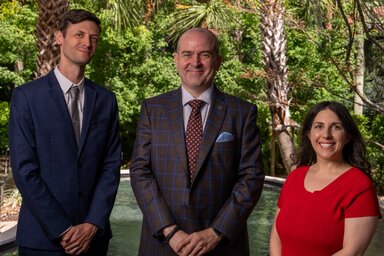


For two doctors at MUSC, working with professional athletes as medical advisors has become a part of their job that doesn’t quite feel like work. Although their roles in assisting these highly trained and talented professional athletes with all their medical needs can be complex and involved, they report feeling privileged to share their skill set with some of the world’s most elite athletes.
A sports medicine expert in lacrosse
It is not uncommon for sports medicine professionals to volunteer to assist athletes during major tournaments and games. For MUSC’s Eugene Hong, M.D., the work might be unpaid, but the level of fulfillment is worth its weight in gold.
Hong, with 30 years of experience in sports medicine, said his passion lies in the game of lacrosse, and for the past 18 years, he has served as a medical advisor for the sport on national and international levels. Having played lacrosse himself growing up, he sees it as “giving back” to the sport he loves.
However, volunteering as a medical advisor for any sport entails not only assuming responsibility and providing leadership but also assuming the status of a trusted expert in all matters medically related to that sport.
Hong is now the chief medical officer for the World Lacrosse Federation, but prior to that, he worked as the lead medical advisor with USA Lacrosse and served as the national team doctor for several USA teams. He has also been an NCAA team physician for 30 years and currently serves as the chief medical officer for Clemson Athletics.
“I set policy for wellness across the board for the teams, and I work on the international governing board for the sport,” he explained.
In fact, in July, Hong was in Tokyo for the Women’s World Championship Lacrosse Tournament.

Hong’s volunteer responsibilities with World Lacrosse include informing and advising the organization on medical- and safety-related issues relevant to the sport; providing oversight and analysis for the collection of data related to injuries; and improving the medical systems, policies and procedures for international lacrosse.
Hong also oversees the World Lacrosse Medical Commission and appoints medical providers with appropriate areas of expertise. He also leads regular meetings and presents best practice recommendations to organizational leadership.
Medical complications in lacrosse, he explained, can run the gamut. Hong said that before the World Championship in Tokyo, they planned for ailments like heat illness and heat stroke, sudden cardiac arrest from commotio cordis, concussion and eye injuries, since eye protection is not required in women’s lacrosse.
To prepare for the 10-day tournament in Tokyo, Hong said they worked closely with officials in Japan to make sure they would have adequately trained staff at the event, resources and space and that the players would be safe.
He reported that during the entirety of the tournament, there were a number of injuries requiring medical attention including: ACL tears, Achilles tendon ruptures, heat illness, upper extremity fractures and medical conditions such as infectious disease and travel-related conditions.
Hong is now looking forward to the Los Angeles Olympics in 2028, where he will serve as the official medical advisor for all lacrosse events.
“Lacrosse hasn’t been in the Olympics in decades, so this is really exciting to see it being brought back and to be involved in that,” he said.
He has already traveled to the International Olympic Committee (IOC) headquarters in Switzerland to meet with other medical professionals involved in the Olympics. He said he looks forward to attending more IOC meetings in 2027.
“We are already deep into the planning for the Olympics and how to prepare for our sport in L.A.,” he added.
Everyone has to pick and choose how to spend their time. I want to give back to this sport with my skill set.
“Everyone has to pick and choose how to spend their time,” Hong said. “I want to give back to this sport with my skill set. The ability to make a difference gives me such joy and professional satisfaction. I feel so fortunate to be able to help improve the health, wellness and safety of these athletes. It’s fulfilling and, you know what? It’s also pretty fun!”
Neurology and sports performance
As the director of the Division of Aerospace and Performance Neurology and an assistant professor in the Department of Neurology, Mark Rosenberg, M.D., approaches human performance through the lens of the nervous system.“The nervous system controls the human body, and approaching human performance from a neurologic perspective allows for significant gains and departs from most other performance programs that look at the body from a bottom-up approach,” Rosenberg explained.
Rather than beginning with muscles, movement or other physical measures of performance, Rosenberg and his neuroscience lab team begin with the system that controls them: the brain and nervous system. That strategy can help them to identify factors affecting performance that more conventional approaches might overlook. Rosenberg treats populations who work in extreme environments, like military operators, pilots and elite athletes.
“Clinically, I will assess the athletes sent to me who have had concussions, blending an approach of performance enhancement and rehabilitation to determine the optimal path for recovery. Similarly, it does not need just to be a head injury to have impairments; it could be poor sleep, stress at home or other illness,” he explained.
Working with athletes on the USA Shooting Team, Olympic hopefuls, collegiate athletes and the South Carolina Stingrays hockey team, Rosenberg helps to identify barriers to improving athletic performance.
“A rapid debrief after competition helps us determine which technical modifications worked for the athlete. For example, one of our USA shooting athletes had difficulty concentrating on a target, only to find she had weakness in her eye muscles. Upon discovering that and working to strengthen them, that difficulty concentrating has improved markedly,” he explained.
He and his team mostly see musculoskeletal and overuse injuries. He noted that the overdevelopment of certain muscles often results in pain on the opposite side of the body, which can be distracting to the athlete and therefore negatively affect performance.

Although many of Rosenberg’s patients are athletes, he was quick to point out that his work can be applied to everyone, regardless of the activity.
“The same insights refined to improve their performance can be applied to nonathlete patients because ultimately, we are all athletes in our own way. We all need to show up consistently and do the best that we can while simultaneously trying to minimize stress, injury and pain,” Rosenberg concluded.
Featured in this article


Theresa Stratford
Theresa Stratford is the editor for MUSC’s newspaper, The Catalyst. She has worked as a writer and editor for 25 years since graduating from the University of South Carolina with a Bachelor of Arts degree in journalism and mass communications. As a writer, she has worked for the federal government in cybersecurity and for the Department of Energy. As both a writer and an editor, she has worked for a variety of syndications, including national magazines, such as Vogue Knitting, as well as many local Charleston and South Carolina publications.
Recent MUSC News stories