

One of the greatest things about golf is that it truly is a lifelong sport. Whether you're playing nine holes with friends or competing in club tournaments, golf provides exercise, camaraderie, and enjoyment at every age. However, even this low-impact game can lead to injuries such as medial epicondylitis, better known as Golfer’s Elbow.
This condition can develop in golfers of any skill level. It occurs when the tendons on the inner side of the elbow become irritated from repetitive stress/microtrauma.
A tight grip, poor swing mechanics, and overuse at the driving range can all contribute to the problem.
The first symptom is often a mild ache on the inside of the elbow. It is more common on the dominant arm, often the trail arm in the golf swing. Over time, discomfort may become more noticeable during the swing, at the time of impact or early follow through. Golfer’s elbow can also cause problems with everyday activity, such as shaking hands, lifting objects, or even turning a doorknob. Ignoring these early warning signs can allow a minor tendon injury to become a chronic condition that takes much longer to heal.
The good news is that most golfers recover without surgery.
The good news is that most golfers recover without surgery. Resting the elbow, modifying practice routines, applying ice after activity, elbow braces, and participating in a structured physical therapy program are usually very successful.
Certain adjustments to equipment can also help, especially appropriately sized grips, which can take pressure off the forearm muscles and tendons during the golf swing.
It is possible to prevent Golfer’s Elbow. Before every round, spend five to ten minutes warming up with gentle stretching and a few easy practice swings. Try to avoid gripping the club too tight and gradually build up your practice sessions.
As an orthopaedic surgeon specializing in sports medicine, my goal is not simply to treat injuries but to help golfers stay on the course. Listening to your body, addressing discomfort early, and practicing smart injury prevention can keep your swing healthy for years to come.
For more information, visit the MUSC Health Orthopaedics & Sports Medicine - Indian Land webpage.
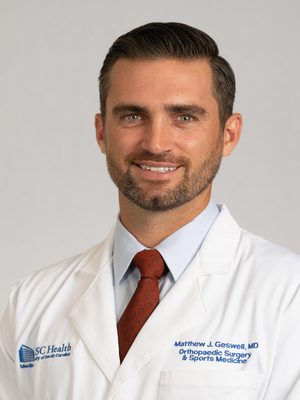
Matthew Geswell, M.D.
- Orthopaedics - Sports Medicine
- Orthopaedics
- Indian Land, SC
- Lancaster, SC
Recent MUSC News stories