

The unexpected death of U.S. Sen. Lindsey Graham from an aortic dissection, also known as an aortic tear, is raising awareness about a condition that doctors and researchers at the Medical University of South Carolina are studying and treating through multiple avenues. MUSC Health has the state’s only comprehensive aortic treatment center.
“Anytime somebody dies suddenly, the first thing I think is it’s probably their aorta. It’s not always the case, but oftentimes it is,” said Sanford Zeigler, M.D., director of thoracic aortic surgery at the center. “What strikes me about this is that it could be preventable with advanced knowledge that there’s a problem.”
Aortic dissection
In an aortic dissection, blood pushes through a break in the lining of the largest artery in the body. It separates, or dissects, the middle layer of the aortic wall from the outer layer and can block blood flow. But Zeigler said it’s possible to catch and treat the problem early in some cases.
“The most important thing that people need to know is if they have a family member who died suddenly without a clear explanation or died from an aortic aneurysm, dissection or rupture, everybody in that family needs to be screened with either a CT scan or an echocardiogram to see if they have an aneurysm as well.”
An aortic aneurysm is a bulge in the aortic wall that raises the risk of a tear. If it bursts, breaking all of the aorta’s layers, it’s called a rupture. In a dissection, there’s a tear but not a complete rupture.
Risk factors
“High blood pressure is a huge risk factor for developing an aneurysm or dissection,” Zeigler said. “Particularly very high blood pressure over the 180s. And drugs like cocaine and methamphetamines cause huge spikes of blood pressure. Smoking is a risk factor for it, too. But for a lot of these dissections, it's really very high blood pressure that's difficult to control or a family history. Awareness is a huge part of the battle.”
Type A versus Type B
That battle involves two types of aortic tears. “Aortic dissections, or really any acute aortic pathology, are typically classified into Stanford Type A versus Stanford Type B. Type A dissection affects the ascending aorta, which is the part closest to the heart and is near the aortic valve and near the coronaries. It’s also near the blood vessels,” Zeigler said.
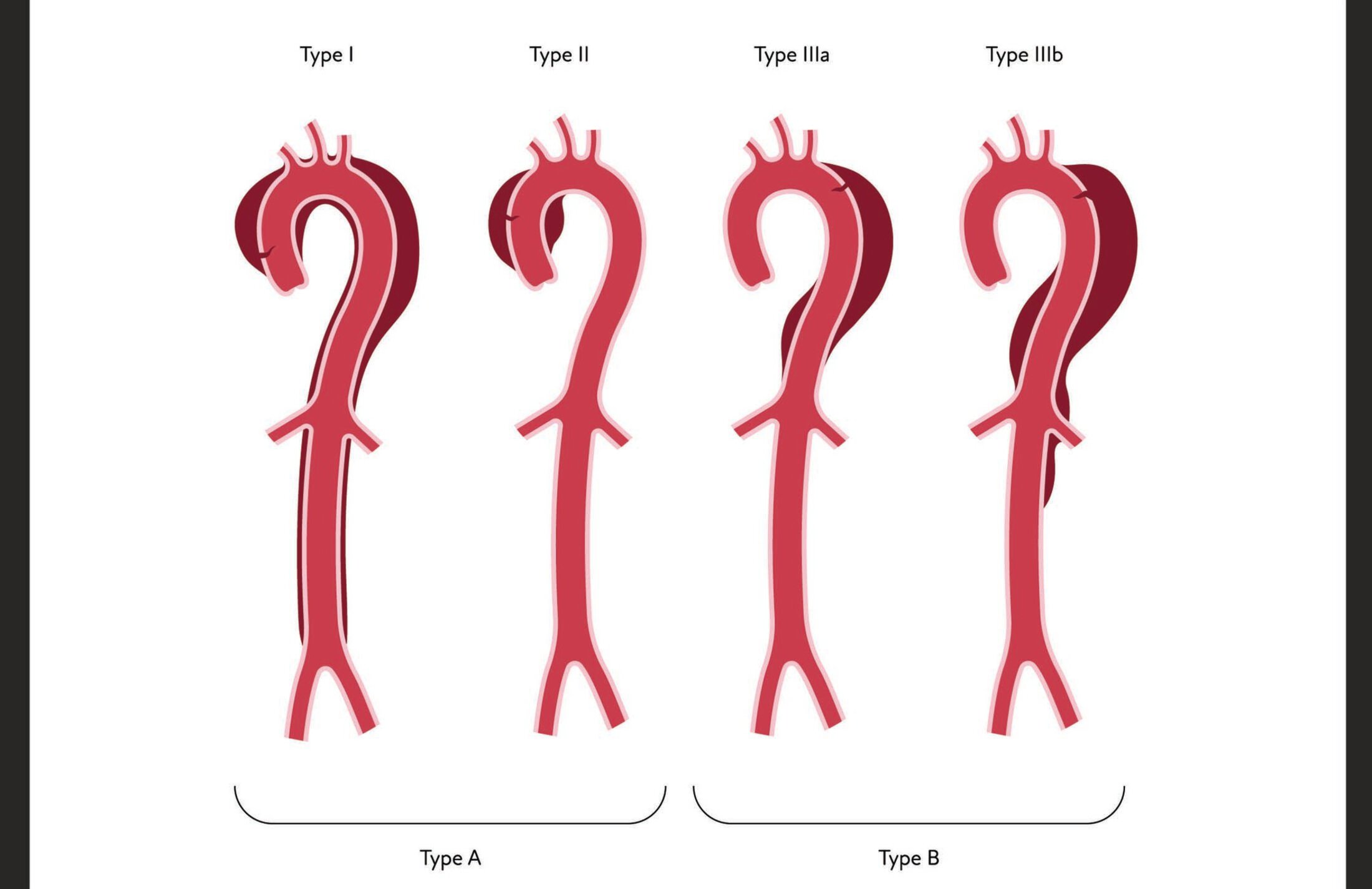
“A Type B dissection occurs downstream of all that in the descending thoracic aorta.”
The type of dissection drives the type of treatment. “Both types are very serious problems, and both typically need ICU-level care.”
Type A is an emergency that requires immediate treatment, Zeigler said. “We almost certainly need some kind of operation before the patient goes home with a Type A aortic dissection. Without surgery, half of those patients will die within two days.”
Type B is less likely to cause a rupture. Treatment often involves lowering blood pressure so there’s less stress on the aortic wall, followed by stenting to help repair the layers back together. “We are able to treat Type B with stents most of the time,” Zeigler said.
“Both types, after a successful repair, require lifelong monitoring of the remaining segments of the aorta that are dissected. It's impossible for us to treat the whole dissection in one operation most of the time because the aorta is about two-and-a-half feet long.”
Symptoms
There are symptoms that show up with both types of dissection that people should be aware of, Zeigler said. “The first warning sign can be the severe chest pain, back pain that is the herald of this event happening. But when people say warning signs, they’re usually talking about something that happens a few days ahead of time so they can head it off before it’s a problem.”
Not in the case of aortic dissections. “There’s usually not something like that. Usually, we’re talking about an acute event. If you recognize that there’s a problem and get to a hospital quickly, a hospital can get you triaged and operated on.”
How MUSC is pushing the field forward
While aortic dissections are considered uncommon, they kill an estimated 13,000 Americans each year. So specialists at MUSC are:
-Taking advantage of new technology to help patients. “One of the things we’re very proud of is that we have access to branched stents, which allows us to treat more of these dissections early on while we still have a chance of remodeling the aorta in a positive way,” Zeigler said.
-Enrolling patients in clinical trials testing new devices. “We’re part of clinical trials where we can treat Type A dissections with stents, although that’s very much in its infancy. And we’ve done that in a handful of patients with reasonable results.”
-Studying molecular mechanisms for aneurysm formation and development. “We can potentially prevent these from happening.”
-Identifying patients with a familial cause of dissections and aneurysms. “We treat those patients more aggressively than somebody with a small aneurysm that isn’t ready for surgery.”
-Managing patients through a genetic cardiovascular program. “It helps us care for patients who have syndromic conditions that put them at risk for dissections at a young age, like Marfan syndrome, Ehlers-Danlos or Loeys-Dietz syndrome.”
Going forward
As Zeigler mentioned, doctors are hoping to one day prevent aneurysms and dissections. But they’re not at that point yet.
“The current state is that we identify patients who have small aneurysms and watch them over time. And when they reach a certain size threshold, where we think dissection is becoming more likely, then we operate and either do a stent to exclude that aneurysm, or we do open surgery to cut the aneurysm out, depending on its location,” Zeigler said.
“But the reality is there are a lot of patients that are walking around with an aneurysm and don’t know they have one. And there’s a lot of patients that have dissections that didn’t have an aneurysm that we would’ve treated. So there’s some pieces of the puzzle that we still don't have.”
Sanford Zeigler, M.D.
Sanford Zeigler, M.D., is a cardiothoracic surgeon who treats adults with both acquired and congenital heart and aortic disease, including coronary artery disease, aortic and mitral valve lesions, aortic dissection, and aortic aneurysms.
Dr. Zeigler has a particular interest in aortic valve repair, aortic dissection, and surgical ablation of atrial fibrillation, and serves MUSC Health as the Director of the Aortic Center.
He completed the Integrated Cardiothoracic Surgery Residency at Stanford University. During his training, he studied under some of the giants of cardiac and thoracic surgery, and developed a unique skill set for treated aortic aneurysms and dissections with both open and endovascular approaches.