
Nearly every career field has its own parlance. It can be a shortcut for communication among insiders; some use it to demonstrate their knowledge of a particular subject.
Often, however, jargon leaves listeners and readers scratching their heads in bewilderment, and speakers and writers can equally become flummoxed when someone just doesn’t “get it.”
Science and medicine are especially challenging. With their complex formulas and long words rooted in Latin and Greek, conversation and text can make even the most enthusiastic audience’s eyes glaze over.
To help graduate students to hone their communication skills, MUSC offers a class called “Scientific Writing as Persuasion.” Taught, in part, by Matthew Greseth, Ph.D., whose research field is virology, the class emphasizes clarity and brevity. Other learning opportunities include digital badges and Three Minute Thesis (3MT) academic competitions that challenge higher-degree students to present the significance of their research in just three minutes to a nonspecialist audience.
Greseth, director of Student Affairs in the MUSC College of Graduate Studies and director of the college’s Science Communications Initiative, explained the motivation for the class as well as the 3MT competition and digital badges.
Q. Why is this class important?
A. We must be able to explain what we as scientists do – why science matters and how it benefits society. While the emphasis on why communication is important might shift from year to year, funding is the main driver. The ability to break down one’s research and explain it in simple terms to a research agency or a nonprofit is critical. Also, social media and other platforms have opened up a whole new world of communication opportunities.
We are passionate about scientific research and take tremendous pride and joy in what we do. I think it’s only natural that we want to share our work with as many people as we can. This course offers students a toolkit to deliver that story effectively to a wide array of audiences.
Q. Can anyone take the course?
The course is required for biomedical research trainees during their first summer because they’re the ones who are in the lab at the bench conducting research and doing the complex work that needs to be explained to a broader audience. The class, however, is also open to all graduate students in the College of Graduate Studies.
Q. What do students learn?
A. Essentially, students are taught how to tailor their message to an array of audiences. The course is 10 weeks, and we use different strategies, from lectures to writing and speaking assignments. The class includes a lot of peer feedback and discussion of different methods for developing and improving their skills.
Q. What does the class involve?
A. The class includes three assignments geared to help students tell their stories to three different audiences. Students are assigned to interview their mentors about their project and write a summary of the project’s background and why it’s important. This can be part of a student’s research profile, posted on the department’s website.
The second assignment involves describing their research projects for a funding agency. Students are assigned to write a summary of their projects and a letter of intent stressing the importance of their work and how it aligns with the agency’s or foundation’s goals.
The third piece is a two-part assignment. Students are required to discuss their research project and write a blog post. They’re asked to describe their research so that anyone can understand it and address why a reader should care about it. They also have to make a 3MT talk, which is a three-minute presentation about their research, for the class.
Q. Are students graded?
A. Yes. The class is for academic credit.
Q. What else can students do beyond the classroom to refine their communication skills?
A. MUSC does offer additional opportunities. Students can participate in MUSC’s annual 3MT competition, from which students can advance to regional and North American competitions if their presentations are selected. They can earn digital badges, which show that a student has a particular skill and has met certain academic requirements. Acquiring digital badges is purely voluntary. MUSC offers three badges, organized in tiers based on their complexity.
Q. What are the requirements to earn a digital badge?
A. Students are required to write a series of news stories and blog posts, give an oral presentation and attend a communications-based workshop or conference in their fields. The third digital badge also requires a student to mentor another student. The mentorship part is important because it gives students the opportunity to take what they’ve learned and help other students along the way.
Q. Why do digital badges matter?
A. Digital badges are becoming more prevalent in the sciences and validate a student’s knowledge and effort. Students can link to their badges on their CVs, digital profiles and even email signatures. A potential employer can open that link and easily identify what skills students learned to acquire that badge. We’ve had about 18 or 20 students earn their first-level badges, and it’s a successful, exciting opportunity to highlight the skills they’ve learned.
Q. What are 3MT talks?
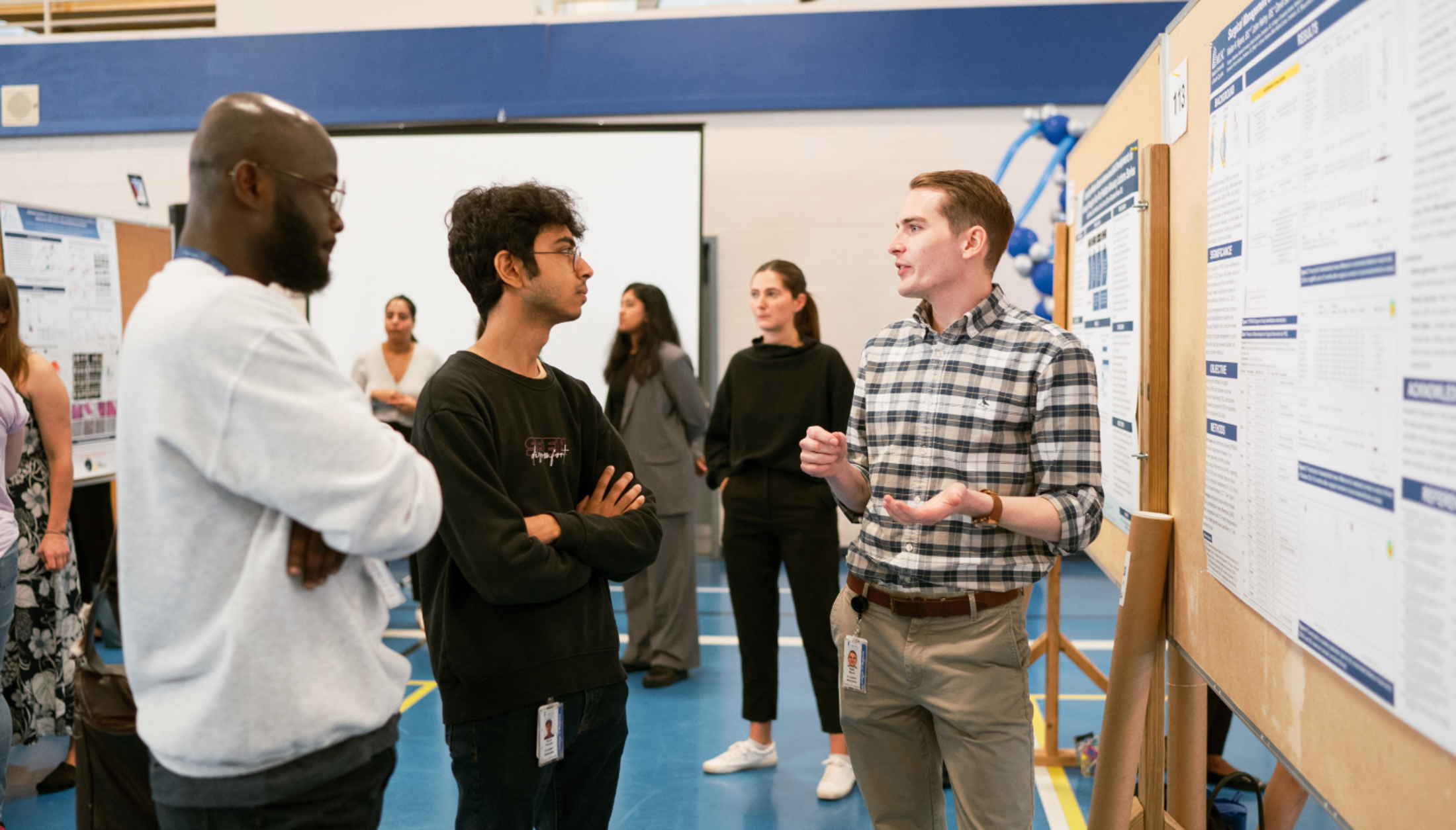
A. The 3MT competition is held annually at MUSC and brings together students from the College of Graduate Studies to showcase the breadth, innovation and impact of their research conducted across campus. Participants must summarize their research in three minutes or less, using language accessible to a nonspecialist audience, with only one slide each to illustrate their points.
Q. Are students judged?
A. Yes. Students are judged on the effectiveness of their message, the content and even their stage presence. The panel includes communicators from across campus, faculty members and other students. Judges pick the top two presenters. A People’s Choice winner is also determined by members of the audience. The first-place winner then represents MUSC at the Southeastern regional competition. The winners in that competition advance to the North American competition.

Margaret Lamb
Margaret Lamb has extensive experience in higher education, health, medical and wellness communications as a writer, editor, spokesperson and manager. A graduate of the University of South Carolina (USC) with a degree in political science, she has worked for USC and Clemson University as well as Hill & Knowlton Public Relations and The Atlanta Constitution.