
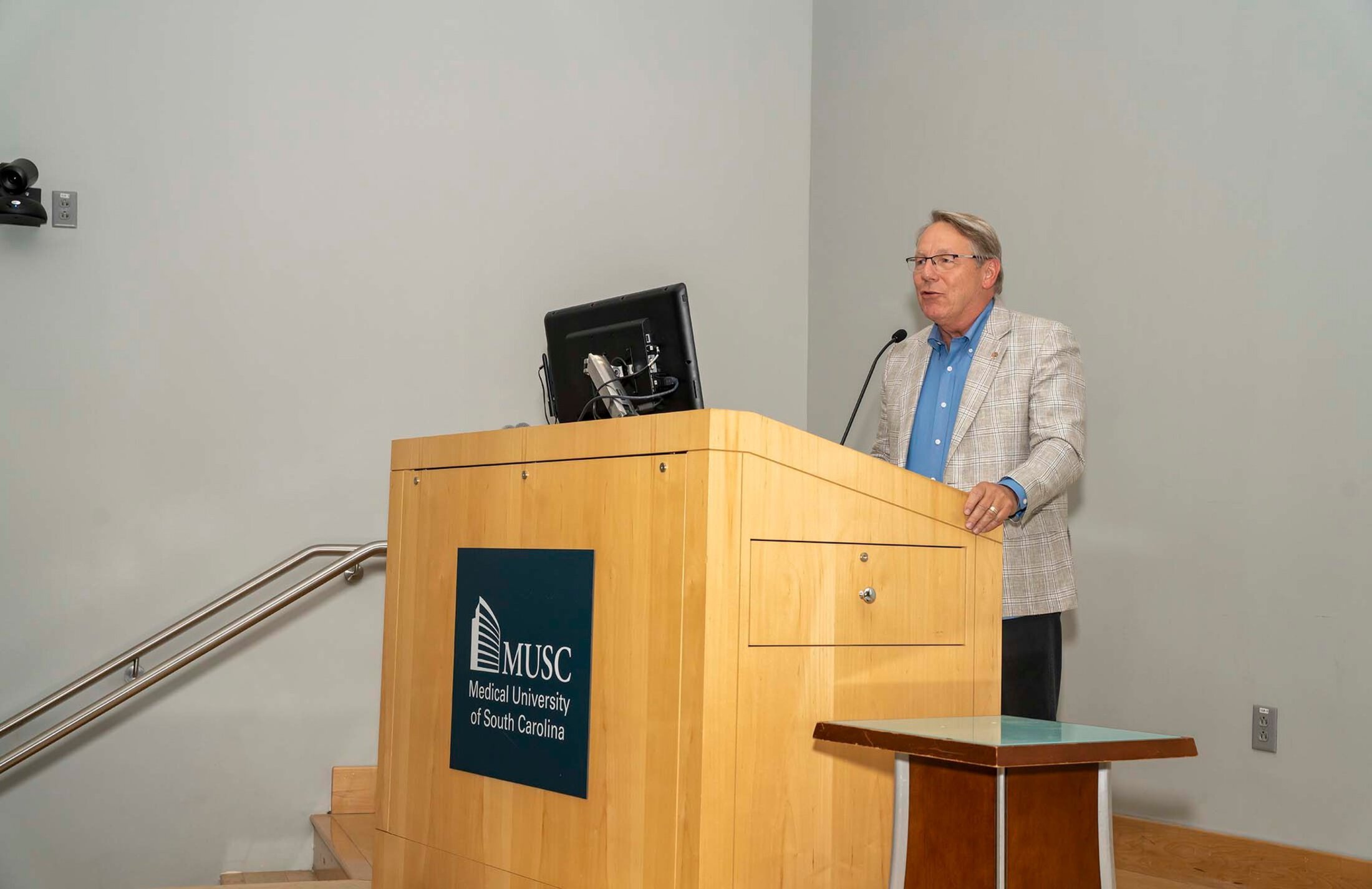
Marion Edward “Ed” Wilson Jr., M.D., Distinguished University Professor of Ophthalmology and the former N. Edgar Miles Endowed Chair of Ophthalmology and Pediatrics at MUSC’s Storm Eye Institute, retired from full-time clinical practice Dec. 31 after 46 years in medicine and nearly 36 years on the MUSC faculty.
As he reflected on his career, Wilson recalled a valuable piece of advice his dad gave him when he was just a boy – the kind of advice you can take to the bank and use to build a successful life.
“Dad always taught me to work hard in sports, academics and life,” Wilson said. “He’d say, ‘You’re not going to be the fastest, the tallest or the smartest, but you can pick an area where you have the skills to be the best and then outwork everybody to get what you want.”
Wilson took that advice to heart and added another goal: mastery in his career field of pediatric ophthalmology. It’s a bit of wisdom that he shares with new physicians just beginning their careers.
“I tell residents and fellows that you have to be a lifelong learner,” he said. “When you finish training, you’re competent, but your training is just the foundation; mastery is something you must achieve on your own.”
Wilson, as the saying goes, “knows whereof he speaks.” One look at his resume shows that he has mastered ophthalmology, leaving it, along with MUSC and countless physicians and patients, better off for his commitment, leadership and expertise.
He is credited with helping to advance the field of pediatric cataract surgery, leading to better outcomes, implants and improved equipment. He also co-wrote, with Rupal Trivedi, M.D., his former fellow and a faculty member at MUSC, the first textbook dedicated entirely to pediatric cataract surgery. That book, which went into a second edition and was translated into Spanish, is used by surgeons all over the world.
Valued mentor
He has mentored students, residents and fellows. And he put MUSC on the world map as a place for young surgeons to come and burnish their surgical techniques, and where parents from across the U.S., as well as Europe, Asia and the Middle East, bring their children for pediatric cataract surgery.
After serving in the Navy, Wilson joined MUSC in 1990, where he redesigned and expanded MUSC’s ophthalmology residency program, serving as its program director for eight years. His vision and leadership earned him the top spot as chairman of the Department of Ophthalmology and director of the groundbreaking Albert Florens Storm Eye Institute, positions that he held for 15 years. For Wilson, these accomplishments are especially gratifying, since he accomplished them in his hometown while working at his alma mater.
Even as he recalled some of his career highlights, Wilson remained modest. “I think I made a real impact on the ophthalmology training program at Storm Eye Institute, and I also had an impact on how cataract surgery is done and how it has evolved for children across the globe,” he said.
Widespread recognition
Circling the globe to restore sight to children has been a defining theme of his career. In 2024, the American Academy of Ophthalmology honored him with its Outstanding Humanitarian Service Award, recognizing decades of hands-on surgical teaching and tireless mentorship as he helped to train surgeons and establish sustainable, sight-saving pediatric programs around the world. From Ethiopia, Indonesia, China and India to Romania, Myanmar, Nepal, Vietnam and a dozen more, Wilson didn’t just travel – he built lasting legacies of care and hope, changing the course of children’s lives across continents through the gift of vision.
And he earned the respect and appreciation of colleagues far and wide.
“Ed’s leadership of the Department of Ophthalmology and Storm Eye Institute will continue to have an impact for many years to come,” said Terrence E. Steyer, M.D., dean of the College of Medicine and vice president for Medical Affairs. “He grew a pediatric ophthalmology program from scratch, and this serves the needs of children across the state and country. He is a strong, yet quiet leader who brought vision and excellence to his role.”
“Dr. Wilson’s career in ophthalmology was one of significant contributions in clinical care, teaching, research, scholarly publications and national service,” said Andrew S. Eiseman, M.D., holder of the Stanley and Theodora Feldberg Endowed Chair, chairman of MUSC’s Department of Ophthalmology and director of the Division of Ophthalmic Plastic and Reconstructive Surgery at the Storm Eye Institute. “He also maintained an extremely busy clinical and surgical practice in pediatric ophthalmology at the Storm Eye Institute, and his legacy will also be remembered for the dozens of residents and fellows that he trained in both the art and science of medicine.”
A witness to changes
Wilson said he’s witnessed incredible changes in medicine over the course of his career – advances in imaging and anesthesia, the introduction of electronic medical records (EMRs) and a fundamental shift in how medicine itself is practiced.
“Ophthalmology was an early adopter of very precise imaging, and the fact that we were making diagnoses and treatment decisions based on imaging led to early machine learning and AI,” he said. “Because of imaging and other breakthroughs, ophthalmology became a leader in minimally invasive surgery, and surgeons were able to achieve outcomes that we had never dreamed of.”
He said improvements in anesthesia have enabled surgeons to operate on infants in the first few weeks of life, when early surgery is crucial for sight-saving outcomes. And EMRs have facilitated the sharing of patient information across institutions. “I’d never go back to paper records,” Wilson said. “The ability to have the medical information on patients who come to us from around the country is invaluable.”
The shift to patient-centered care and shared decision-making has given patients and families a bigger role in their treatment, Wilson said. “When I was in training, doctors didn’t want to give people options because they thought it would show that medicine was not perfect, and doctors didn’t have all the answers. However, we now know that patients and parents, when the patients are children, will be much more compliant, and thus will have better outcomes, if they are fully informed and involved in the decisions about care.”
His takeaway, and another piece of advice that he gives to residents and fellows, is that doctors do not have patients. Rather – patients have doctors. The patient chooses the doctor.
“It is always the patient’s choice,” he said. “We must earn their confidence. It’s appropriately humbling to think of health care in that way.
Personal connection
Wilson’s clinical and research success was shaped by more than long hours and hard work. It was influenced by his son, Leland, who was born with cerebral palsy and eye problems that led to low vision, considered legally blind, and nystagmus when Wilson was a fourth-year medical student at MUSC. “My son has taught me a lot, particularly about health care communication and compassion,” he said. “After Leland was born, I talked with many different specialists about his condition, and I vowed to communicate to families as a physician the way I so desperately wanted to be talked to as a father of a child with special needs. These experiences also gave me the desire to shadow pediatric ophthalmologists.”
Before Leland was born, Wilson became interested in microsurgery. He found a lab where he could do dissection under a microscope to see if he had a knack for that kind of precision.
“I found that I liked it, and that gradually led me to apply for training in ophthalmology,” he said.
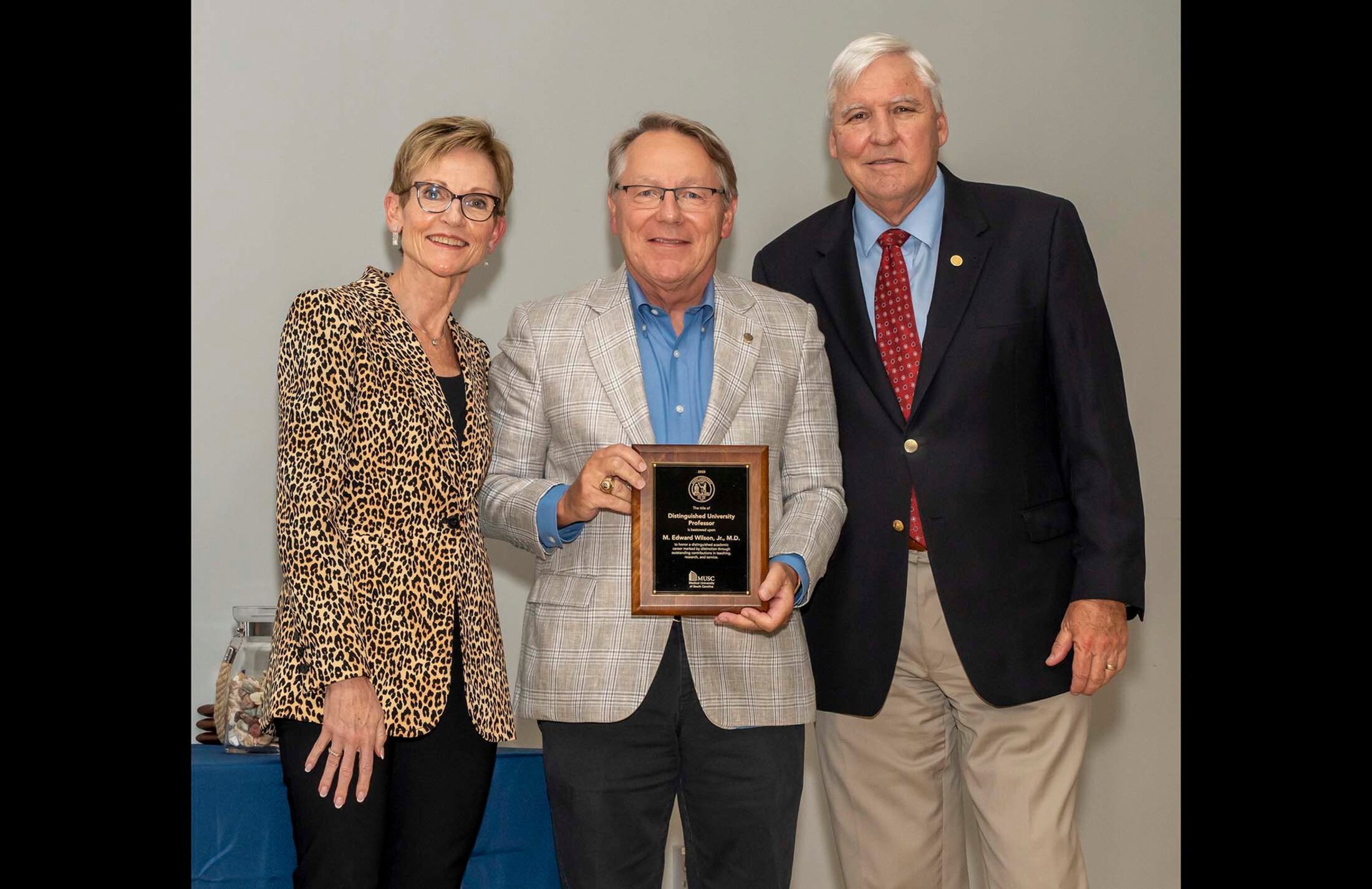
Fast forward nearly 50 years and while Wilson is retiring from ophthalmology as a means of making a living, he said he’s not abandoning innovation and the social and teaching realm of ophthalmology.
“I want to keep writing editorials. I have some research grants and special projects I’m involved in, and I’ll supervise a clinic and do a little bit of teaching,” he said. “I still plan to accept speaking invitations to be a guest speaker at conferences and medical institutions.”
An eye for photography
Still, don’t be surprised to see Wilson toting his Sony and Nikon cameras around town and out in the wild. An amateur wildlife photographer, Wilson said he’s looking forward to photographing birds of prey, such as eagles, osprey and hawks, more frequently, along with owls and shorebirds like herons and egrets that populate the Lowcountry.
“Photography makes me happy, and since I traded my golf clubs for a camera, it’s a good way to get my steps in, too.”
Gratitude after heartbreak
Nowadays, Wilson is grateful for every step he takes. In 2021, he was hit by a car while crossing Rutledge Avenue in a designated walk zone. Soon after he recovered from the hip and leg damage, his wife of 46 years, Donna, died.
“I was not in a good place,” he said.
Wilson’s life, however, was about to take on elements of a Hallmark story. Months later, he received a condolence email from his high school sweetheart, who had learned on social media that his wife had died.
“Her name was Vicky, and we were in high school in Fort Lauderdale, but our families moved away – mine back to Charleston and hers to Cambridge, Ohio,” he said. “We never really broke up; we just got pulled away from each other before even graduating from high school. We hadn’t been in contact in more than 50 years.”
Within a year, they rekindled their romance, and in 2023, they married.
“I’m a different person,” Wilson said. “My son loves her, and our families get along beautifully. We want to spend as much time traveling and doing things together as we can,” he said. “Truthfully, if not for Vicky, I would not be looking at this next phase of life with such optimism and excitement.”
Saying goodbye - and saying hello to next phase
In preparation for this next phase, he spent the last 12 months saying goodbye to his patients, many of whom are now in college or have grown up and started families of their own.
“Families tend to stick with the same doctor, and it’s been quite gratifying to be part of their lives and see my young patients grow and flourish,” he said. “I have even had the privilege to operate on babies of the babies I did surgery on decades ago. Congenital cataracts are often genetic, but if we can give them a normal life with sight, it is not a curse on the family. We can restore joy and hope. These families all become like family to me.”
Many would agree that Wilson exemplifies the very words he has shared with residents and fellows throughout his career: Leave the profession better than it was when you entered. And if you’re lucky enough, you may be innovative and move your field forward.
“I know that I have helped to train many ophthalmic surgeons who will carry the eyecare field to places I cannot even imagine, all for the benefit of the patients we serve,” he said.

Margaret Lamb
Margaret Lamb has extensive experience in higher education, health, medical and wellness communications as a writer, editor, spokesperson and manager. A graduate of the University of South Carolina (USC) with a degree in political science, she has worked for USC and Clemson University as well as Hill & Knowlton Public Relations and The Atlanta Constitution.