
Doctors at MUSC Health are trying a new way to help patients in their adult emergency departments get care more quickly. “We know that waiting time is wasted time,” said Jeanhyong “Danny” Park, M.D., director of Innovation for the Division of Emergency Medicine Telehealth.
“We wanted to transform waiting time into a valuable asset. We can begin testing and care while our patients are waiting in the ED.”
That transformation involves something most people became familiar with during the pandemic: telehealth. In telehealth, also known as telemedicine, a health care provider uses a secure internet connection to communicate with the patient using a specially designed device. Patients who need to see a doctor in person will still get to do that during their ED visits. Telehealth is just a new addition to the process of getting started.
Marc T. Bartman, M.D., directs the Division of Emergency Medicine Telehealth at the Medical University of South Carolina. He described how the new addition works in both the University Hospital’s and Ashley River Tower’s emergency departments.
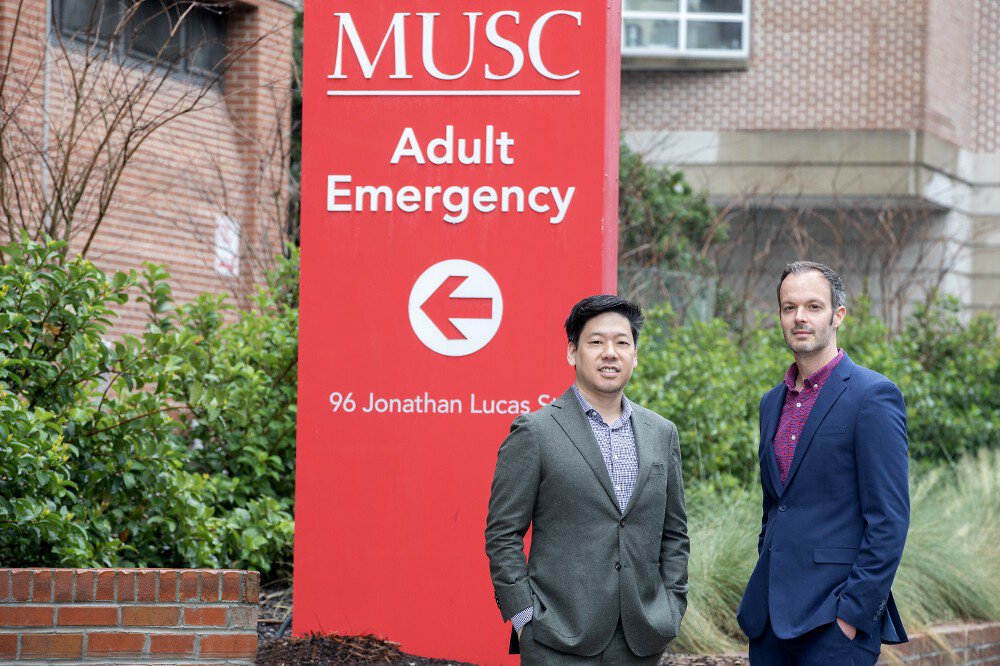
Dr. Park, left, and Dr. Bartman are using existing space in new ways to improve the experience for patients in the Emergency Departments in University Hospital and Ashley River Tower in Charleston.
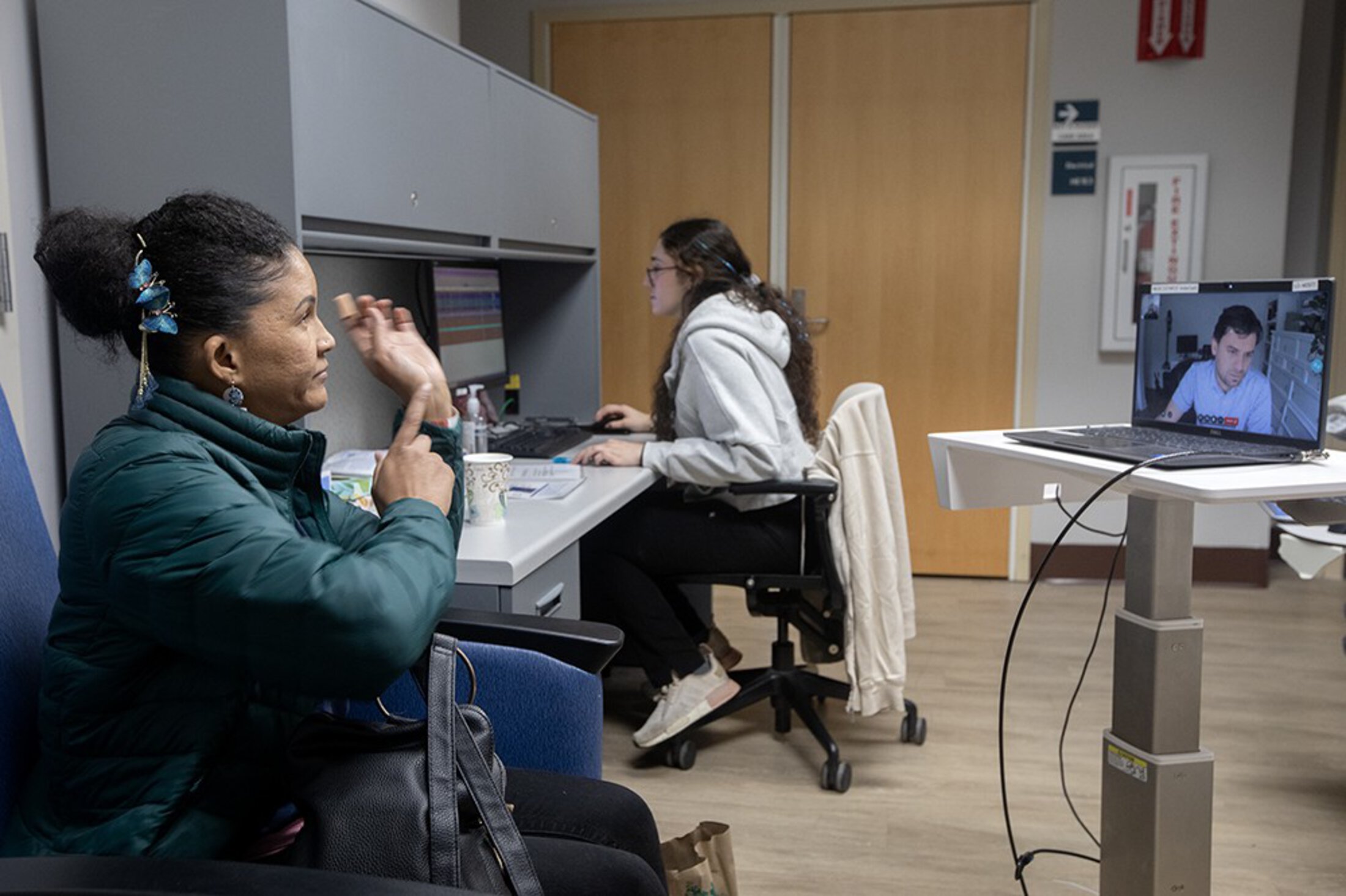
“Shortly after checking in, the patient is placed in a dedicated consult room. A virtual ED provider performs the initial medical screening exam, orders and documentation as part of the normal triage process. They also assign a patient to the appropriate treatment space,” Bartman said.
“If the patient remains in the waiting room, the virtual provider uses the platform and its machine-learning algorithms to monitor the progress of the patient’s workup and update the patient about their care plan and treatment progress. They provide an extra set of eyes in the lobby. Their assistance improves the triage process by identifying sick patients earlier, improving care and safety.”
This strategy is part of his team’s answer to what’s become a national crisis: the overcrowding of emergency departments. According to research published in the journal Healthcare, factors driving that overcrowding include:
- Patients coming in with more urgent and complex problems.
- An increase in elderly patients.
- Poor and uninsured people who don’t have primary care.
- An increase in the number of people accompanying patients to the ED.
Bartman definitely sees the impact in Charleston. “The main hospital has been operating at greater than 100% capacity for a majority of the past month, resulting in excessive ED boarding and crowding,” he said.
Boarding refers to patients remaining in the Emergency Department while they wait for an inpatient bed. “At one point during a recent week, we had 99 patients in the department despite only having 42 licensed beds,” Bartman said.
So his team has started using available spaces more effectively, transforming them into private areas for virtual consultations. “This early engagement with a provider means that we can initiate patient-specific diagnostics sooner, including ultrasounds and CT scans,” Bartman said.
“By starting a workup earlier, we are saving our patients time and money. Our goal is to increase the quality, efficiency and overall experience our patients have while in the ED.It really helps with patient flow. Patients and staff are loving it, and it's improving our ED metrics.” By metrics, he means measures used to gauge how well things are working.
Park said the program, just about a month old, doesn’t operate every day yet. That gives them a basis for comparison. “We run it Monday, Tuesday, Wednesday, Friday currently, as a test. And then we're hoping to expand that in the future.”
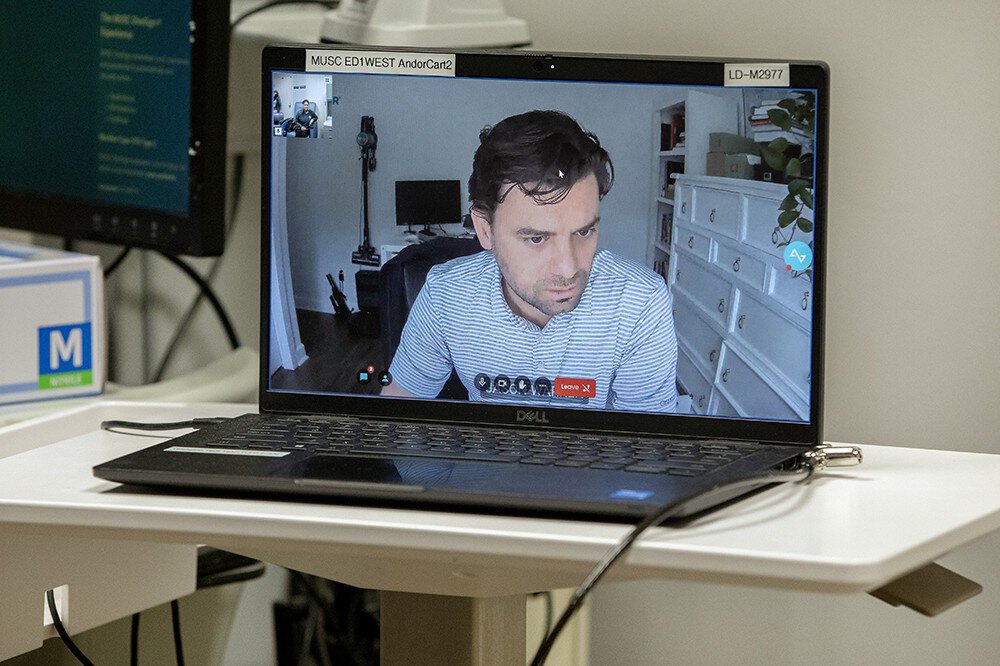
Nurse practitioner Jason Warren meets with Emergency Department patients while they're waiting to see a doctor to get enough information to order tests tailored to their conditions.
One metric that jumps out: people’s willingness to stick around long enough to see a doctor. “During the hours that we're running the program, ‘left without being seen’ rates were historically low, almost zero,” Park said.
Park, Bartman and their colleagues have plans to streamline emergency care even further. For example, Park said, eventually, they plan to offer patients the chance to stay in touch with the medical team through a secure messaging system.
“They can message back and forth during their entire stay. It will enhance their experience. They’ll be able to do things as simple as requesting a blanket or asking for water or asking, ‘When am I going to be getting an X-ray?’ Anywhere in the ED, they’ll be able to communicate with our staff.”
That will be another change for a place that’s evolving with the support of MUSC’s Center for Telehealth. Bartman said that evolution will eventually include hospitals in the MUSC Regional Health Network. For now, it’s the only such program in the Charleston area and one of a handful in the entire country. He hopes the word spreads.
“When patients come in and have to wait, they're frustrated. But I want the public to know that we, on the other side, are also frustrated – not only because our work slows down, but we feel bad that’s happening. We knew we needed to change that somehow. This idea came out of the need to serve the public.”
This is the first service launched by the Division of Emergency Medicine Telehealth. It was made possible by the dedication, hard work and collaboration of the Center for Telehealth, AndorHealth and the clinical service team. That team includes the advanced practice providers at the Emergency Department, their leader Jason Warren, DNP, nursing managers/clinical staff leaders Jennifer Hanna, Sarah Brown and Jennifer Kelly, the medical director of the Emergency Department, Dr. Morsal Tahouni and the Emergency Department Chairwoman Dr. Diann Krywko. The Division of EM Telehealth is working on multiple innovative projects to extend the reach of its providers outside of the walls of the ED. From pre-hospital to post-discharge, the goal is to increase the efficiency and quality of patient care.