
A powerful artificial intelligence (AI) tool could give clinicians a head start in identifying life-threatening complications after stem cell and bone marrow transplants, according to new research from MUSC Hollings Cancer Center.
For many patients, a stem cell or bone marrow transplant is lifesaving. But recovery does not end when patients leave the hospital. For some, serious complications can emerge months later, often without warning.
One of the most challenging is chronic graft-versus-host disease (GVHD), a condition in which immune cells from the transplant attack a patient’s healthy tissues. The disease can affect multiple organs, including skin, eyes, mouth, joints and lungs, causing long-term disability or even death.
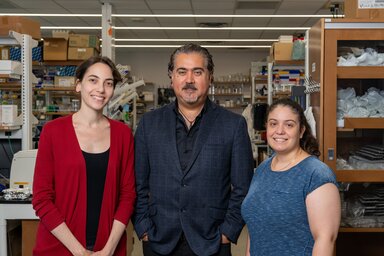
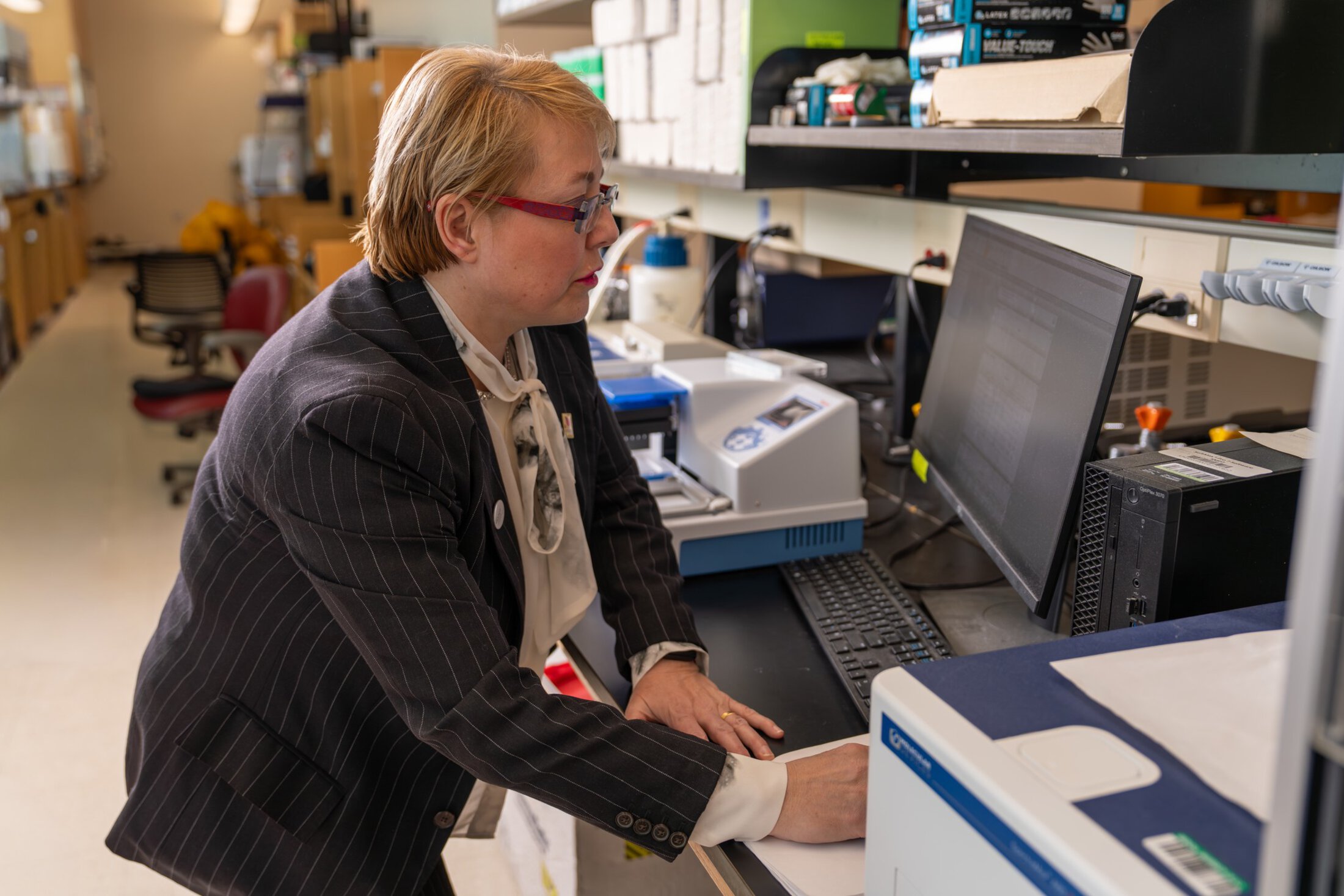
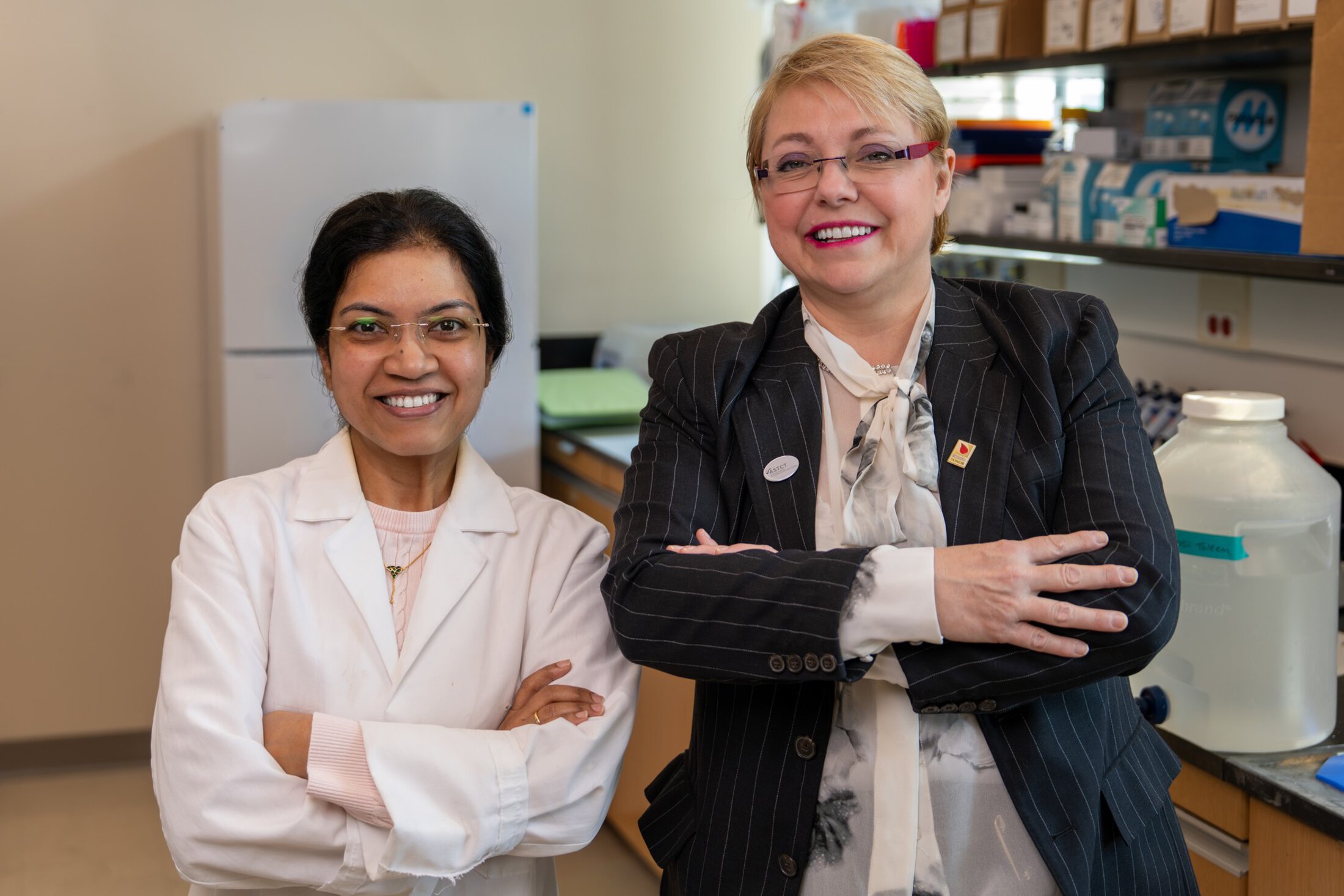
Now, researchers, led by Sophie Paczesny, M.D., Ph.D., co-leader of the Cancer Biology and Immunology Research Program at Hollings, as well as Michael Martens, Ph.D., and Brent Logan, Ph.D., with the Center for International Blood and Marrow Transplant Research at the Medical College of Wisconsin, have developed an AI-based tool that may help clinicians to identify patients at higher risk for chronic GVHD before symptoms appear, opening the door to earlier monitoring.
Applying machine learning to immune-related proteins and validated clinical information, the team developed a tool – called BIOPREVENT – that estimates a patient’s future risk of developing chronic GVHD and dying from transplant-related causes. The study, published in the Journal of Clinical Investigation, combines immune biomarkers, clinical data and machine learning to create a tool for real-world risk prediction.
A window of opportunity after transplant
Despite major advances in transplant care, chronic GVHD remains one of the leading causes of illness and death after transplant. But the disease does not begin when symptoms appear; the biological changes that drive it start much earlier.
The first few months after a transplant are particularly critical. Patients may feel well, but immune activity beneath the surface can already be setting the stage for complications.
“By the time chronic GVHD is diagnosed, the disease process has often been unfolding for months, quietly hurting the body,” Paczesny said. “We wanted to know whether we could detect warning signs earlier, before patients feel sick, and soon enough for clinicians to intervene, before the damage becomes irreversible.”
Turning blood tests into early warnings
To do so, the researchers analyzed data from 1,310 stem cell and bone marrow transplant recipients across four large, multicenter studies. Blood samples collected 90 to 100 days after transplant were tested for seven immune proteins linked to inflammation, immune activation and regulation, and tissue injury and remodeling. The immune biomarkers used in BIOPREVENT were identified and validated in an earlier study led by Paczesny.
Those biomarkers were combined with nine clinical factors, including patient age, transplant type, primary disease and prior complications, drawn from transplant registries. In the U.S., transplant centers are required to submit detailed, transplant-specific data to the Center for International Blood and Marrow Transplant Research, with additional review for clinical trial patients. According to Paczesny, that standardized information helped to ensure that the model was built on consistent, high-quality clinical data.
The team tested several machine-learning approaches to see whether they could predict patient outcomes more accurately than traditional statistical methods. The best-performing model, based on a statistical technique called Bayesian additive regression trees, became the foundation for BIOPREVENT.
It was important to us that this not remain a theoretical model or a tool limited to a single institution. Making BIOPREVENT freely available helps ensure that researchers and clinicians can test it, learn from it and, ultimately, improve care for transplant patients.
From clinical algorithm to real-world tool
The results showed that models combining blood biomarkers with clinical data consistently outperformed models based solely on clinical data, especially in predicting transplant-related mortality. The team further validated the tool in an independent group of transplant recipients, confirming that it reliably predicted risk beyond the patients used to build the model.
BIOPREVENT was also able to separate patients into low- and high-risk groups, with clear differences in their outcomes up to 18 months later. Notably, different biomarkers predicted different transplant outcomes, underscoring that chronic GVHD and transplant-related death are at least partially driven by distinct biological factors. For example, one blood biomarker was closely linked to the risk of death after transplant, while others were better at signaling who would later develop chronic GVHD.
To make the research usable beyond the study, the team developed BIOPREVENT into a free, web-based application. Clinicians can enter a patient’s clinical details and biomarker values and receive personalized risk estimates over time.
“It was important to us that this not remain a theoretical model or a tool limited to a single institution,” Paczesny said. “Making BIOPREVENT freely available helps ensure that researchers and clinicians can test it, learn from it and, ultimately, improve care for transplant patients.”
A step toward more personalized transplant care
For now, BIOPREVENT is intended to support risk assessment and clinical research – not to guide treatment decisions. The next step, Paczesny said, will be conducting carefully designed clinical trials to test whether acting on these early risk signals, such as closer monitoring or preventive therapies for high-risk patients, can improve long-term outcomes.
More broadly, the study reflects a shift toward precision medicine in transplant care, using data to tailor follow-up to each patient’s individual risk.
“This isn’t about replacing clinical judgment,” Paczesny emphasized. “It’s about giving clinicians better information earlier so they can make more informed decisions.”
Although additional validation is needed before the tool can become part of routine care, the researchers believe that this approach represents an important step toward preventing one of transplant medicine’s most serious complications.
“For patients, the uncertainty after transplant can be incredibly stressful,” Paczesny said. “We hope that tools like BIOPREVENT can help us see what’s coming sooner and eventually lessen the toll of chronic GVHD.”

Sophie Paczesny, M.D., Ph.D.
Dr. Paczesny's laboratory is internationally recognized for its expertise and achievements in the Hematopoietic Stem Cell Transplantation (HSCT) field. She has pioneered the study of proteomics/biomarkers for complications post allogeneic HSCT and is now transitioning the laboratory work into clinical practice. She also has extensive expertise in the cancer immune tumor microenvironment, inflammation and alarmins, T lymphocyte biology and mechanisms of immunity and tolerance as well as translating novel drug-targetable biomarkers to treatment.
References
Michael J. Martens, Debjani Dutta, Yongzi Yu, Lisa E. Rein, Jerome Ritz, Brent R. Logan and Sophie Paczesny. The BIOPREVENT machine learning algorithm predicts chronic graft-versus-host disease and mortality risk using post-transplant biomarkers. Journal of Clinical Investigation [16 February 2026]. doi: 10.1172/JCI195228.
Grants from the National Cancer Institute (R01CA264921), National Heart, Lung, and Blood Institute (U10HL069294, U24HL138660, P01HL158505) and Eunice Kennedy Shriver National Institute of Child Health and Human Development (R01HD074587) supported this research.
Hayley Kamin
Communications Manager
Hayley Kamin is the communications manager for the Hollings Cancer Center Communications and Marketing team, having joined the team in 2025 after three years as a communications specialist at the National Institutes of Health (NIH). As a science communicator with a Ph.D. from the University of Florida, she has extensive experience translating complex research into clear, engaging content. Her career has included roles at the NIH’s National Institute of Mental Health and the American Psychological Association, where she led content development and editorial strategy, developed science and health communications and worked with researchers and clinicians to strengthen public understanding of research.
Contact Hayley at kamin@musc.edu.
Recent Cancer Research stories