
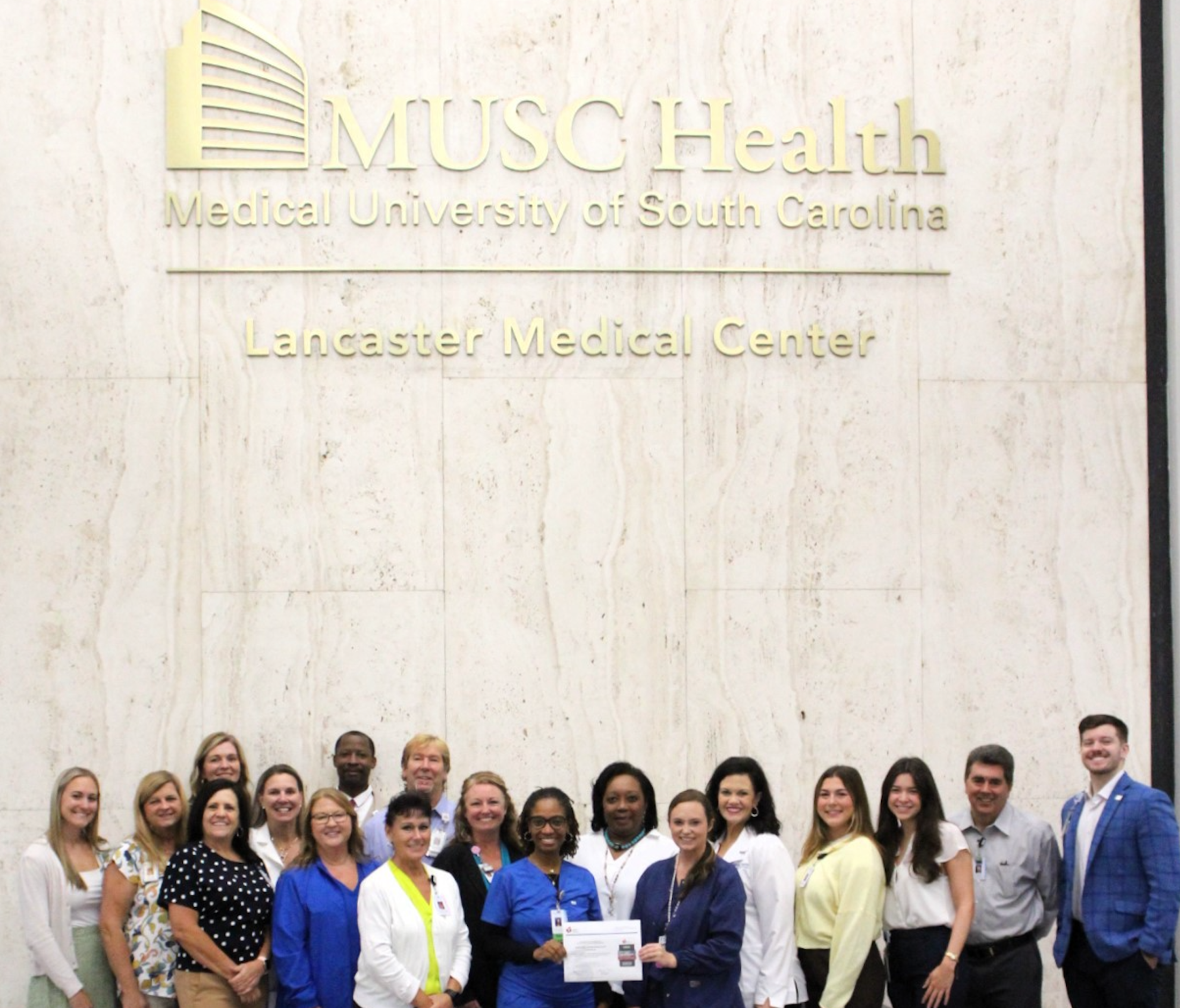
LANCASTER, S.C. (July 14, 2026) – MUSC Health Lancaster Medical Center has received two American Heart Association Get With The Guidelines achievement awards for demonstrating a commitment to following the latest research-based guidelines for the treatment of heart disease and stroke, helping to save lives, support recovery and reduce hospital readmissions.
Heart disease and stroke are the No. 1 and No. 4 causes of death in the United States, respectively, according to the American Heart Association’s 2026 Heart Disease and Stroke Statistics Report. Studies show that patients can experience better outcomes when care teams consistently follow evidence-based treatment guidelines.
Get With The Guidelines puts the expertise of the American Heart Association and American Stroke Association to work for hospitals nationwide, helping to ensure that patient care aligns with the latest science-backed guidelines. Through this initiative, MUSC Health Lancaster Medical Center qualified for the awards by demonstrating a sustained commitment to improving the quality of cardiovascular care.
“MUSC Health Lancaster Medical Center is committed to delivering high-quality care by adhering to the latest treatment guidelines and streamlining processes to ensure timely, appropriate care for heart attacks and strokes,” said J. Scott Broome, CEO of MUSC Health-Catawba Division. “Get With The Guidelines programs help our teams to put proven science into practice every day, supporting better outcomes so more people in Lancaster and Chester counties can live longer, healthier lives.”
This year, MUSC Health Lancaster Medical Center received these achievement awards:
· Get With The Guidelines Rural Stroke Gold award.
· Get With The Guidelines Stroke Silver Plus award with Target: Stroke Honor Roll Elite and Target: Type 2 Diabetes Honor Roll.
“These awards reflect MUSC Health’s commitment to caring for people in their community who need cardiovascular care,” said Karen E. Joynt Maddox, M.D., chair of the American Heart Association Quality Oversight Committee. “By following the American Heart Association’s quality improvement protocols, MUSC Health Lancaster Medical Center can help advance our shared vision of better patient outcomes, fewer readmissions and lower mortality rates – a win for patients, families and healthcare systems.”
###
About MUSC
Founded in 1824 in Charleston, MUSC is the state’s only comprehensive academic health system, with a mission to preserve and optimize human life in South Carolina through education, research and patient care. Each year, MUSC educates nearly 3,500 students in six colleges and trains more than 1,060 residents and fellows across its health system. MUSC leads the state in research funding from the National Institutes of Health, including National Institute of General Medical Sciences COBRE awards. For information on our academic programs, visit musc.edu.
As the health care system of the Medical University of South Carolina, MUSC Health is dedicated to delivering the highest-quality and safest patient care while educating and training generations of outstanding health care providers and leaders to serve the people of South Carolina and beyond. In 2025, for the 11th consecutive year, U.S. News & World Report named MUSC Health University Medical Center in Charleston the No. 1 hospital in South Carolina. To learn more about clinical patient services, visit muschealth.org.
MUSC has a total enterprise annual operating budget of $10.1 billion. The more than 36,200 MUSC members include world-class faculty, physicians, specialty providers, scientists, contract employees, affiliates and care team members who deliver groundbreaking education, research and patient care.
About Get With The Guidelines
Get With The Guidelines® is the American Heart Association/American Stroke Association’s hospital-based quality improvement program that provides hospitals with the latest research-based guidelines. Developed with the goal of saving lives and hastening recovery, Get With The Guidelines has touched the lives of more than 18 million patients since 2001. For more information, visit heart.org.
Recent News Releases stories