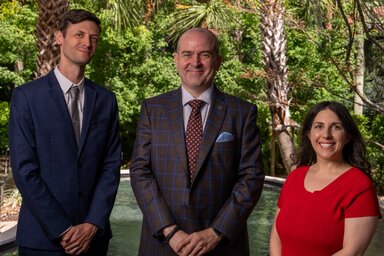


A new collaboration between the Medical University of South Carolina (MUSC) and the University of Florida (UF) is taking a cutting-edge approach to transforming healthcare research and outcomes across the Southeast. The Southeastern Health AI Consortium supports interdisciplinary teams addressing major regional health challenges by leveraging artificial intelligence (AI), large clinical datasets and combined institutional expertise. Backed by $6.6 million in funding, the projects span a broad array of focus areas that affect South Carolinians, Floridians and the broader Southeast region, including mental health, maternal health, stroke, brain health and advanced therapies.
The initiative is spearheaded by leaders from both institutions, including Jesse S. Goodwin, Ph.D., MUSC’s chief innovation officer; Marylyn Ritchie, Ph.D., MUSC’s chief artificial intelligence officer; Patrick A. Flume, M.D., the associate vice president for Clinical Research and co-PI for the South Carolina Clinical & Translational Research (SCTR) Institute; and Elizabeth A. Shenkman, Ph.D., co-director of the University of Florida’s Clinical and Translational Science Institute.
“This scale and diversity enable collaborative opportunities and insights that would not be achievable by a single institution alone,” said Goodwin, reflecting on the promise of the new partnership.
The funding opportunity offers two grant tracks for MUSC-UF collaborations: Novel Health Insights and Methodologic Innovation. Novel Health Insights will fund six multi-institutional teams up to $400,000 over two years to address critical evidence gaps in real-world care and generate preliminary data for large external grant proposals. Methodologic Innovation provides two teams up to $100,000 in one-year seed funding to develop new approaches in health services research, biomedical informatics or data science. The initiative is deliberately structured to balance innovation with practical clinical application, reflecting the importance of developing new research methods while also tackling real-world clinical questions.
All projects include collaboration between MUSC and UF investigators and incorporate either an AI-focused component or lay the foundation for future AI applications. These teams include members with a wide range of expertise, such as backgrounds in data science, implementation science and early-career investigator mentorship, to name a few. Beyond funding, the consortium actively supports team formation and cross-institutional collaboration, helping investigators to connect and develop competitive, high-impact proposals. The initiative’s central aims are to create transformative research partnerships, accelerate AI-enabled discoveries and position MUSC- and UF-led teams for major national funding opportunities.
Flume explained that the consortium embodies the Clinical and Translational Science Award’s (CTSA) – of which MUSC and UF are both part – mission of developing innovative cross-disciplinary research across hubs and applauds its goal of harnessing the power of AI in a responsible and scientifically rigorous way. “AI offers tremendous potential in looking at these large data sets, but we also must learn how best to use and trust AI in this research,” he said. “We need to develop innovative methods of exploring the data and then validate those methods so they can be used by others.”
The leaders of this initiative share a belief that AI will have a meaningful, transformative impact on the future of healthcare, far beyond passing trends or surface-level applications. “Meaningful use of AI is defined by its ability to produce actionable insights that improve clinical outcomes, operational efficiency or population health,” said Ritchie. “The consortium prioritizes alignment with real health challenges and rigorous oversight to ensure impact beyond technical novelty.”
Shenkman shares the belief that real-world, measurable benefits from AI use are not hypothetical dreams but entirely possible with the proper infrastructure and partnership. “For example, maternal morbidity and mortality due to hypertensive disorders of pregnancy can potentially be reduced through more rapid identification of high-risk mothers,” she said. “The partnership and associated data assets provide a unique opportunity to develop algorithms to identify those at risk so that interventions can be implemented earlier.”
A core objective of the collaboration is to train the next generation of researchers at the intersection of AI, clinical care and population health in a way that ensures real-world results. Each funded project includes early-career investigators, helping to build a pipeline of scientists skilled in advanced data science and collaborative research.
“The consortium balances innovation with implementation through a structured governance model,” explained Goodwin. “Projects were evaluated for both strategic value and feasibility. This ensures that AI advances are paired with clear pathways for application in clinical and research settings.”
By combining populations from both South Carolina and Florida, the collaboration uniquely expands both data access and intellectual collaboration. “The MUSC-UF partnership is uniquely positioned to lead AI-enabled research because of the breadth of our patient populations and the range of communities within which care is delivered,” said Shenkman.
Flume agreed. “Now investigators have the opportunity to access and work with talent beyond their own institution, building stronger teams.”
This initiative, he added, positions MUSC and UF at the forefront of AI-enabled health research, combining data, technology and collaborative expertise to accelerate discovery, improve patient care and train future leaders in translational science. Its innovative structure, namely its structured governance model, ensures alignment, accountability and strategic direction.
“This foundation positions the collaboration for sustained impact as AI in healthcare continues to evolve,” said Ritchie. “We hope this model can serve as an example for other collaborations to follow.”
Southeastern Health AI Consortium grant awardees
| Title | MUSC PI | UF PI |
| Transforming Depression Treatment for Individuals with Likely Incurable Cancer: Electronic Health Record Large Language Model-Based Identification | Evan Graboyes, M.D. Professor of Otolaryngology |
Qianqian Song, M.D. Assistant professor and director of Bioinformatics |
| Automated Speech and Language Assessment to Improve Diagnosis of Neurodegenerative Disorders | Federico Rodriguez-Porcel, M.D. Associate professor of Neurology |
Nikolaus McFarland, M.D., Ph.D. Clinical professor of Neurology |
| Improving Maternal Mental Health Screening Using Large Language Model-based Artificial Intelligence | Constance Guille, M.D. Professor of Psychiatry and Behavioral Sciences |
Yonghui Wu, Ph.D. Associate professor and chief data scientist |
| Precision Pregnancy Digital Twins: A Collaborative Pilot for AI-Driven Intervention Modeling | Kelly Hunt, Ph.D. Professor of Public Health Sciences |
Dominick Lemas, Ph.D. Assistant professor of Health Outcomes and Biomedical Informatics |
| Integration of Demographics and Medical Imaging Utilizing Artificial Intelligence and Fluid Dynamics to Improve Stroke Risk Prediction and Develop Personalized Carotid Disease Management | Ravi Veeraswamy, M.D. Professor of Surgery |
Gilbert Upchurch Jr., M.D., DHA Professor of Vascular Surgery |
| A Novel Approach for Building and Optimizing Outcome Prediction Models for Multiple-Heterogeneous Cohorts: A Case Study Using a Multicomponent Intervention in Mild Cognitive Impairment | Stephanie Aghamoosa, Ph.D. Assistant professor of Neuropsychology |
Glenn Smith, Ph.D. Professor of Neuropsychology |
| AI-Enhanced Team Monitoring to Improve Youth Mental Health Referrals in Schools | Colleen Halliday, Ph.D. Associate professor of Psychiatry and Behavioral Sciences |
Joni Splett, Ph.D. Associate professor of Psychology |
| A Portfolio of Use Cases to Enable Privacy-Preserving AI with Federated Learning: Applications to Advance Gene and Cellular Therapies and Address Brain Health | Paul Heider, Ph.D. Assistant professor of Public Health Sciences |
Jie Xu, Ph.D. Assistant professor of Health Outcomes and Biomedical Informatics |
About MUSC
Founded in 1824 in Charleston, MUSC is the state’s only comprehensive academic health system, with a mission to preserve and optimize human life in South Carolina through education, research and patient care. Each year, MUSC educates nearly 3,500 students in six colleges and trains more than 1,060 residents and fellows across its health system. MUSC leads the state in research funding from the National Institutes of Health, including National Institute of General Medical Sciences COBRE awards. For information on our academic programs, visit musc.edu.
As the health care system of the Medical University of South Carolina, MUSC Health is dedicated to delivering the highest-quality and safest patient care while educating and training generations of outstanding health care providers and leaders to serve the people of South Carolina and beyond. In 2025, for the 11th consecutive year, U.S. News & World Report named MUSC Health University Medical Center in Charleston the No. 1 hospital in South Carolina. To learn more about clinical patient services, visit muschealth.org.
MUSC has a total enterprise annual operating budget of $10.1 billion. The more than 36,200 MUSC members include world-class faculty, physicians, specialty providers, scientists, contract employees, affiliates and care team members who deliver groundbreaking education, research and patient care.
About the South Carolina Clinical & Translational Research Institute
The South Carolina Clinical and Translational Research (SCTR) Institute is the catalyst for changing the culture of biomedical research, facilitating sharing of resources and expertise and streamlining research-related processes to bring about large-scale change in the clinical and translational research efforts in South Carolina. Our vision is to improve health outcomes and quality of life for the population through discoveries translated into evidence-based practice. To learn more, visit https://research.musc.edu/resources/sctr
Sophia Barry Gordon
Sophia Barry Gordon is the science writing and communications program coordinator at the South Carolina Clinical & Translational Research (SCTR) Institute. She holds a Master of Science degree from New York University and is currently a Ph.D. candidate at the University of Birmingham (UK).
Recent MUSC News stories