
What’s in a capsule, a vaccine or an allergy medicine? Most of us check the active ingredients, but what’s not on the label is just as important.
It’s the basic research and the dedicated researchers who work painstakingly to develop, test and advance treatments and medications that heal, cure and maintain a patient’s health.
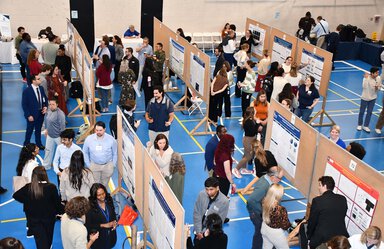
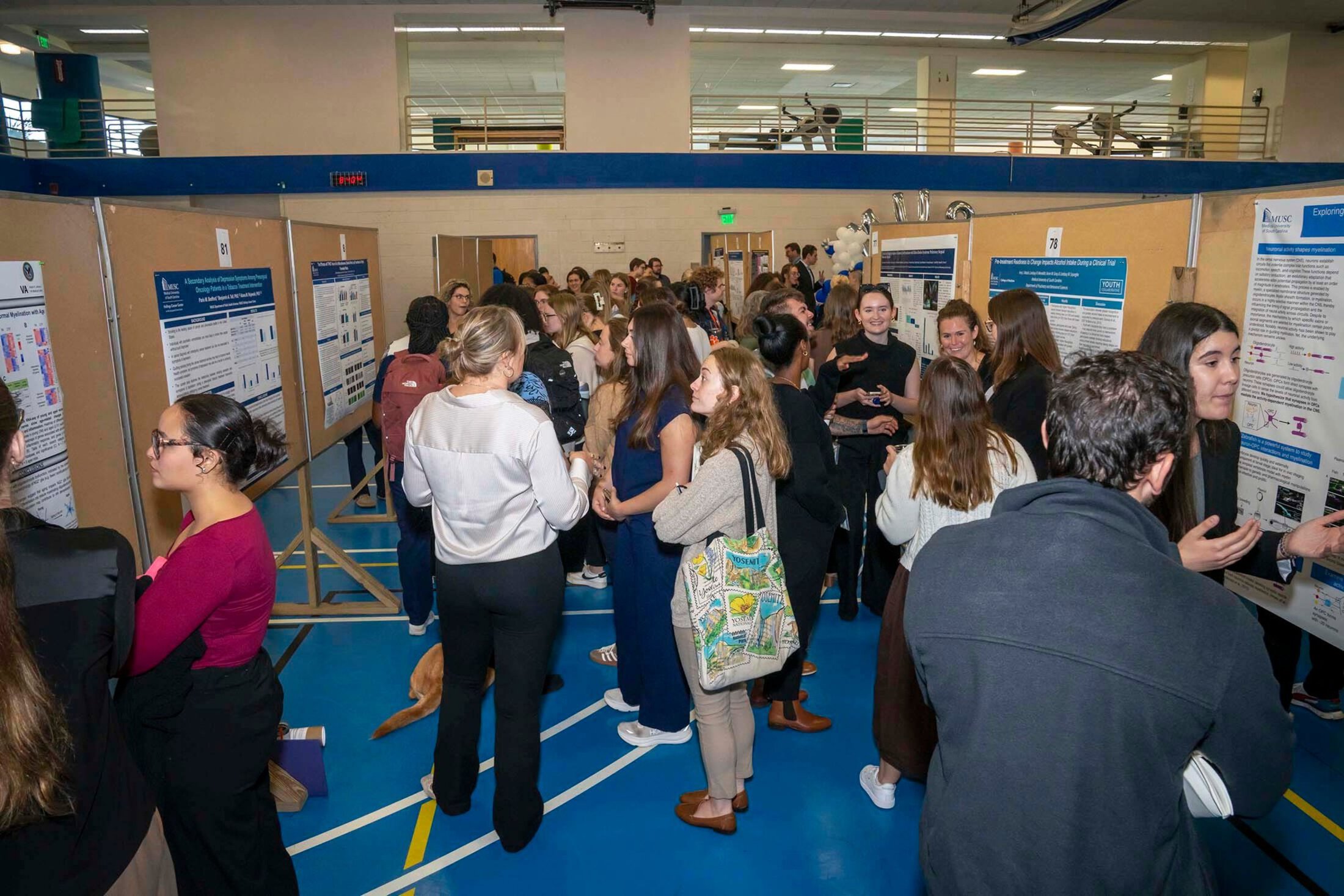
For nearly 60 years, the Medical University of South Carolina has showcased such work by students and postdoctoral researchers at the annual Perry V. Halushka Research Day, named in honor of Dean Emeritus of the College of Graduate Studies Perry V. Halushka, M.D., Ph.D.
The latest Research Day showcased 249 projects, including 170 posters and 79 talks, from all of MUSC’s six colleges.
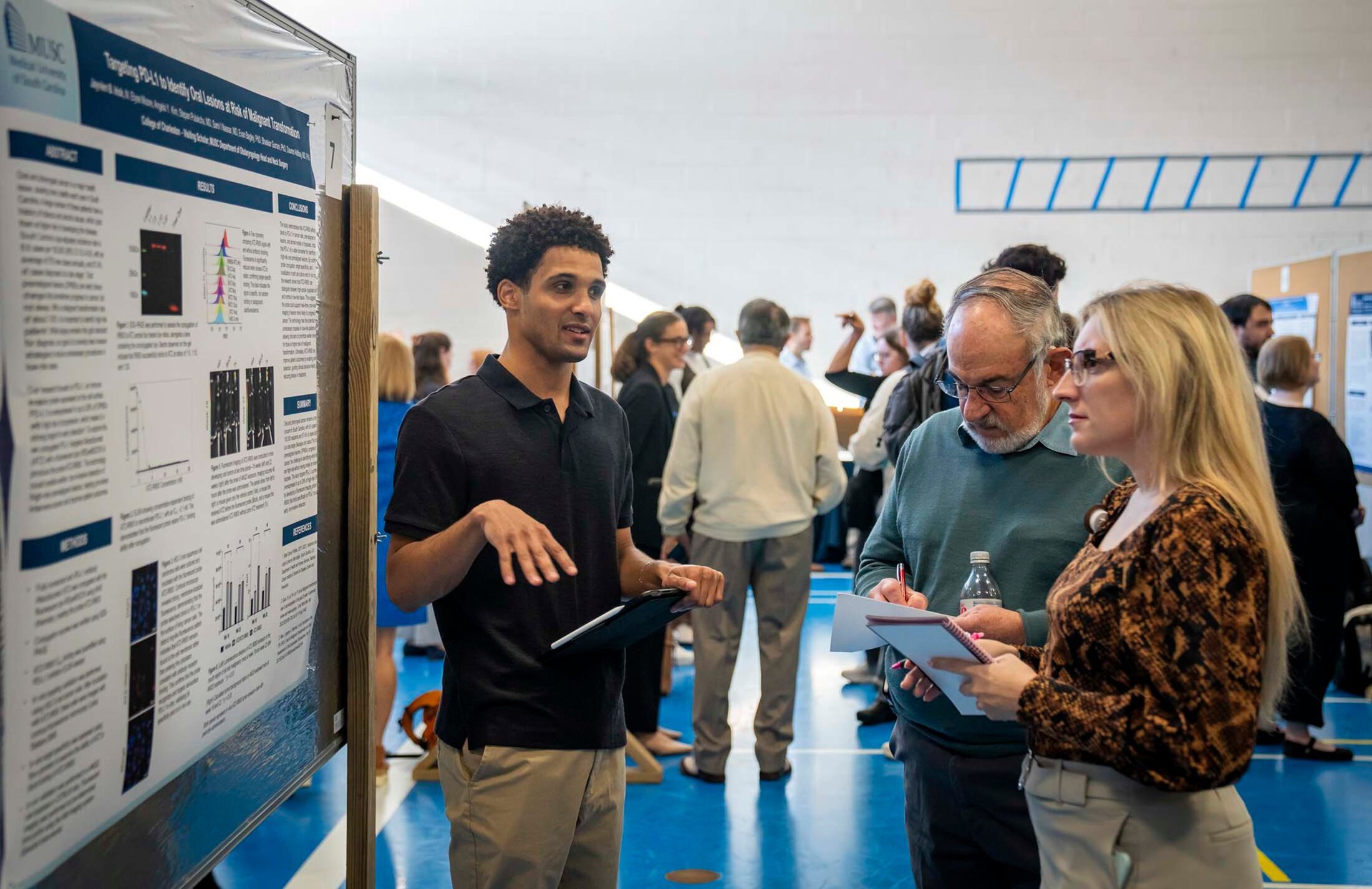
Michael Bouchard, Ph.D., serves as dean of MUSC’s College of Graduate Studies, which sponsors the event. He said Research Day is important because it shows the innovative research underway by students and post-docs.
“This is the research that will drive the development of the treatments and medicine of tomorrow,” Bouchard said. “Sometimes we forget that every medical treatment started out as somebody’s research project in the lab. Research Day lets us highlight this basic concept. It gives us the opportunity to honor and show how basic research is improving patient outcomes in South Carolina and across the nation.”
Bouchard said the event also shows that participants are expanding their ability to do scientific research. “We are able to see their progression and to see them mature as drivers of scientific discoveries.”
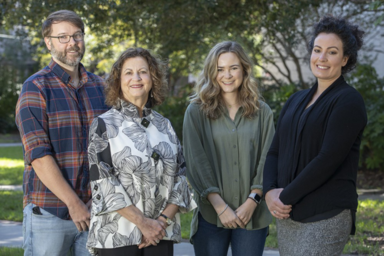
Among those recognized were lab technician Kirsten Kelly and second-year medical student Simran Singh. Both took different routes to MUSC. Kelly is a former teacher, and
Singh did research at the University of North Carolina before entering medical school at MUSC.
Kirsten Kelly
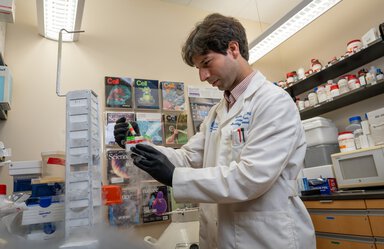
Kelly works in the lab of Amanda LaRue, Ph.D., of the Veterans Administration. Kelly took first place in the poster session, winning both the Lowcountry Center for Veterans Research Award and the Research Specialist/Lab Technician Category. She is part of a team examining a possible genetic link between post-traumatic stress disorder and bone health in veterans.
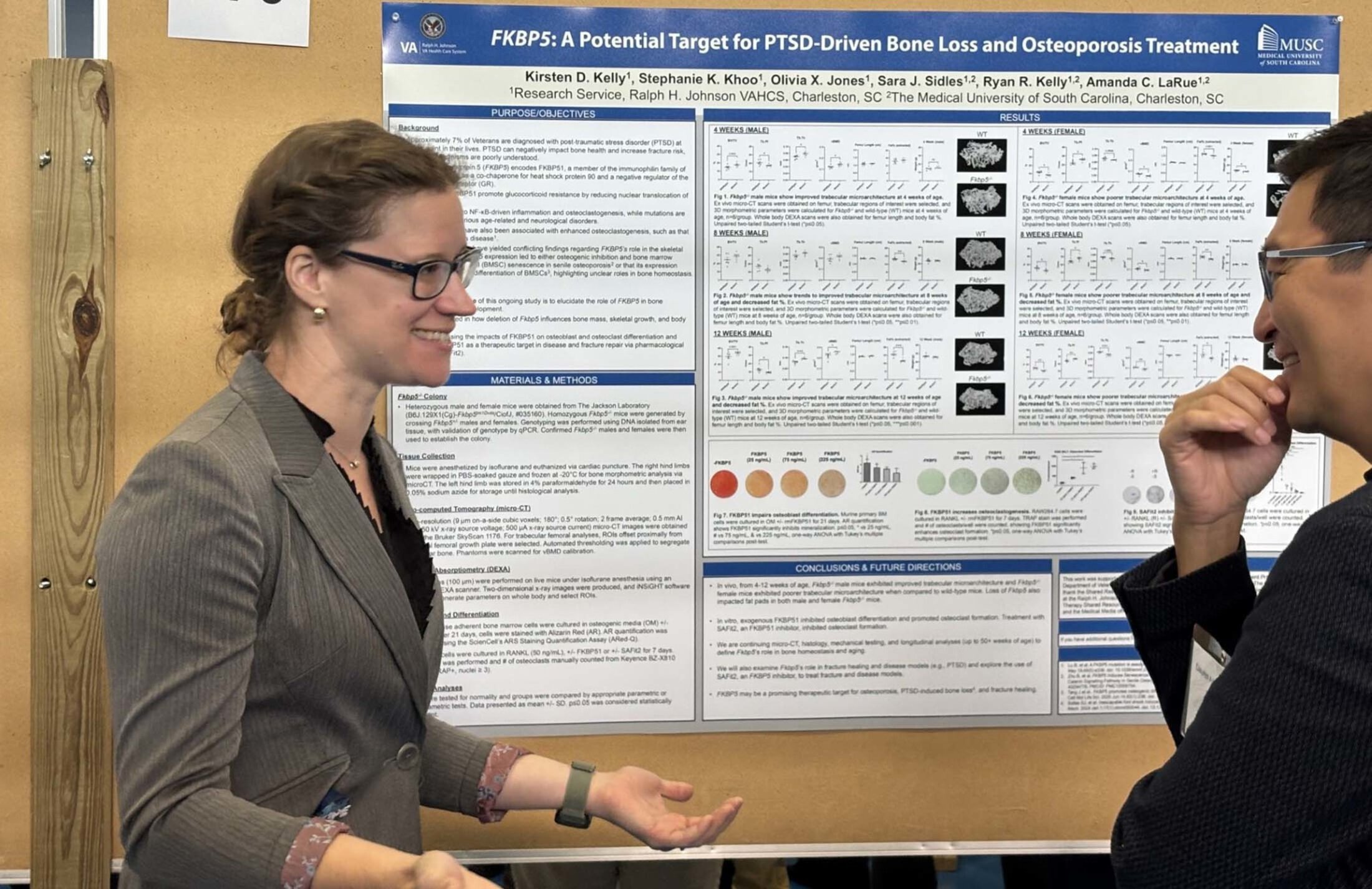
“About 7% of the veteran population will be diagnosed at some point with PTSD,” Kelly said. “Originally, it was thought to be only a mental disorder that affects the brain and mood, but PTSD is now being studied holistically since it impacts the entire body.”
Bone health is one area that has been identified as being negatively affected by PTSD. It puts veterans at higher risk for fractures and slower healing.
“Our lab looks at everything through the lens of bone,” Kelly said. “We know that PTSD negatively impacts bone health, but we are exploring why this happens and what can be done to prevent it. We believe that there is a genetic predisposition for PTSD-driven bone loss.”
Kelly and her team are studying a specific gene, FKBP5, and the protein FKBP51, which is regulated by the gene. The protein and the gene have been linked to PTSD by other researchers.
“What we are hypothesizing is that FKBP5, through the manipulation of the protein FKBP51, could be a target for treating PTSD-driven bone loss. Our hope is that this research will inform future medical practices for the treatment of osteoporosis, fractures and bone diseases in veterans diagnosed with PTSD.”
Their research is in the first year of a four-year VA Merit grant. In a related study, Kelly and her team, under the direction of Larue, are also studying other PTSD comorbidities and their impacts on PTSD-driven bone loss.
For Kelly, her job is a dream come true.
“I’m dyslexic, so I struggled with math, so I decided to major in art instead because I’d always liked art and kids,” she said. After graduating from High Point University with a degree in art education, she took a job teaching art in Charleston schools.
Ten years later, the career picture became clear: She needed a career change. Having done scientific illustrations for LaRue for a few years, she was familiar with her research and was hired by LaRue in 2022 to be a lab technician.
The transition from paint and paper to cells and computers was smooth because a remarkable amount of crossover exists between being an art teacher and a lab tech, Kelly said.
“In teaching, I would study the works of professional artists at museums and look for ways to teach that to my students. In my job now, I read a lot of research papers and translate them into how we can use them in our lab,” she said. “Both involve problem solving, creative thinking and organizational skills, and I still use my art background to illustrate articles for publications.”
She also appreciates being able to give back to a community that has served and sacrificed. “Veterans have specific health issues they deal with due to their service to the United States,” she said.
“Veteran research is incredibly important because these issues may be overlooked when looking at impact in the general population. I love working in VA research because I truly feel like I can make a difference.”
Simran Singh
Singh was a first-place poster session winner as well, earning awards from the Center for Healthy Aging and in the Clinical/Professional/Dental I category. She presented information on her work with David Taber, Pharm.D., a professor in the College of Medicine’s Department of Surgery. They studied kidney transplant access for older adults. Specifically, they examined transplant rates and outcomes in patients 65 and older.
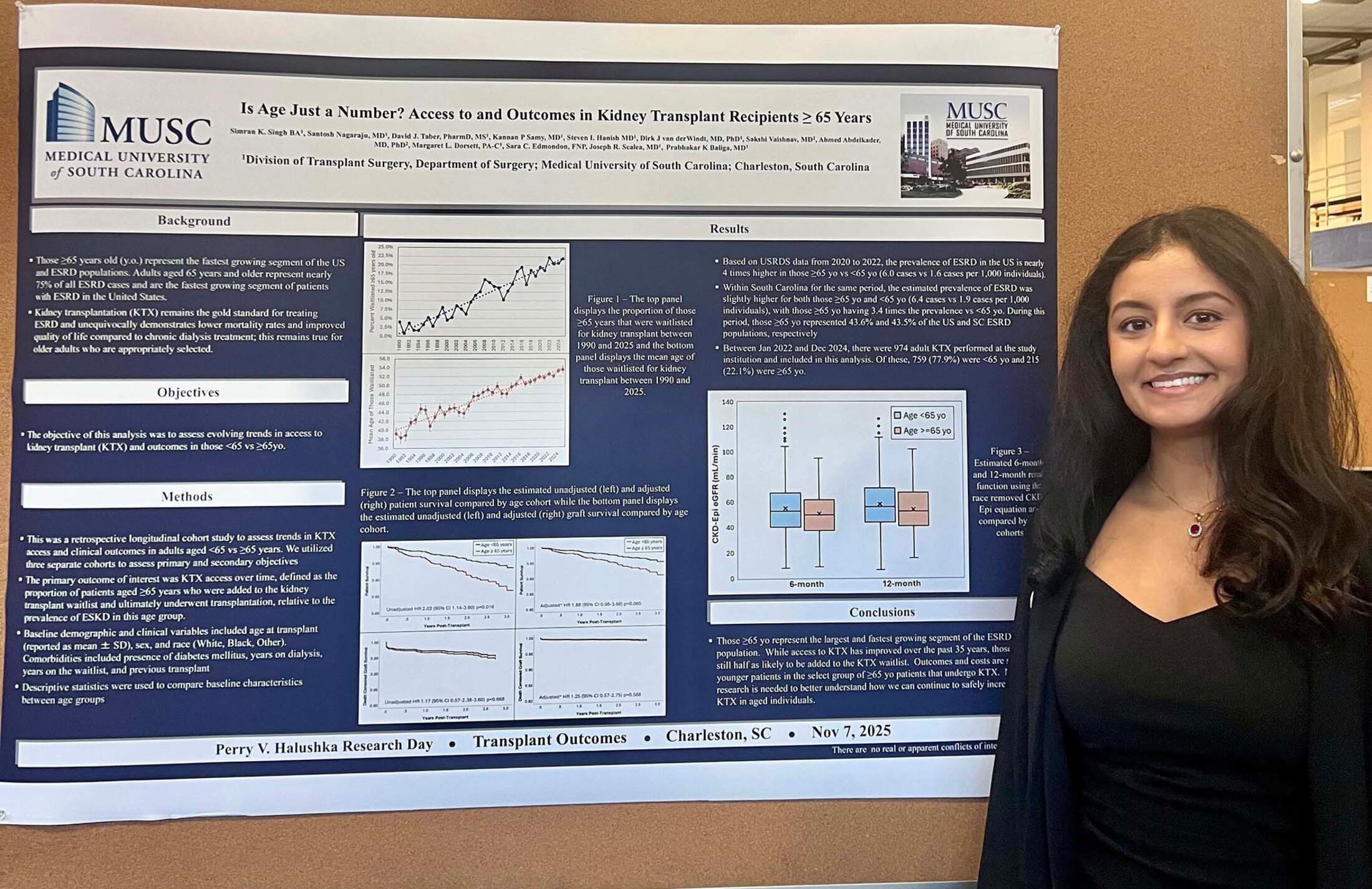
“People 65 and older are the fastest growing segment of end-stage renal disease, making up 75% of all the cases in the United States, but they’re half as likely to be put on a transplant list,” Singh said.
She and Taber examined MUSC kidney transplantation numbers from January 2022 to December 2024. “We wanted to do a holistic review approach, looking at patients’ physiological age as opposed to just their biological age, their overall health, co-morbidities and any underlying health conditions that could affect their success after a kidney transplant,” she said.
The results showed that of the 974 adult kidney transplantations, 759 were performed in patients age 65 and younger while 215 were performed in patients older that 65. Outcomes for older patients, including post-acute care and hospital costs, were similar to those of patients 65 and younger.
“We did not find any statistical significance,” Singh said. “What we have seen is kidney transplants have improved over the last few years, but we found that people over 65 are half as likely to be added to the transplant list.”
Singh said their research is particularly relevant because kidney transplantation is the gold standard for treating this condition. “The evidence shows that patients who undergo kidney transplants have lower mortality rates and improved quality of life as opposed to dialysis, which limits patients’ way of life.”
Still, more research is needed, Singh said. “Our study was foundational. There’s definitely more work to be done to determine how to safely increase access and better address the needs of this population.”
Singh, who researched and contributed to the final paper and the poster, has led research on dialysis, patient outcomes and the patient experience at UNC-Chapel Hill. She is a graduate of UNC with a major in global health and a minor in chemistry and medical Spanish.
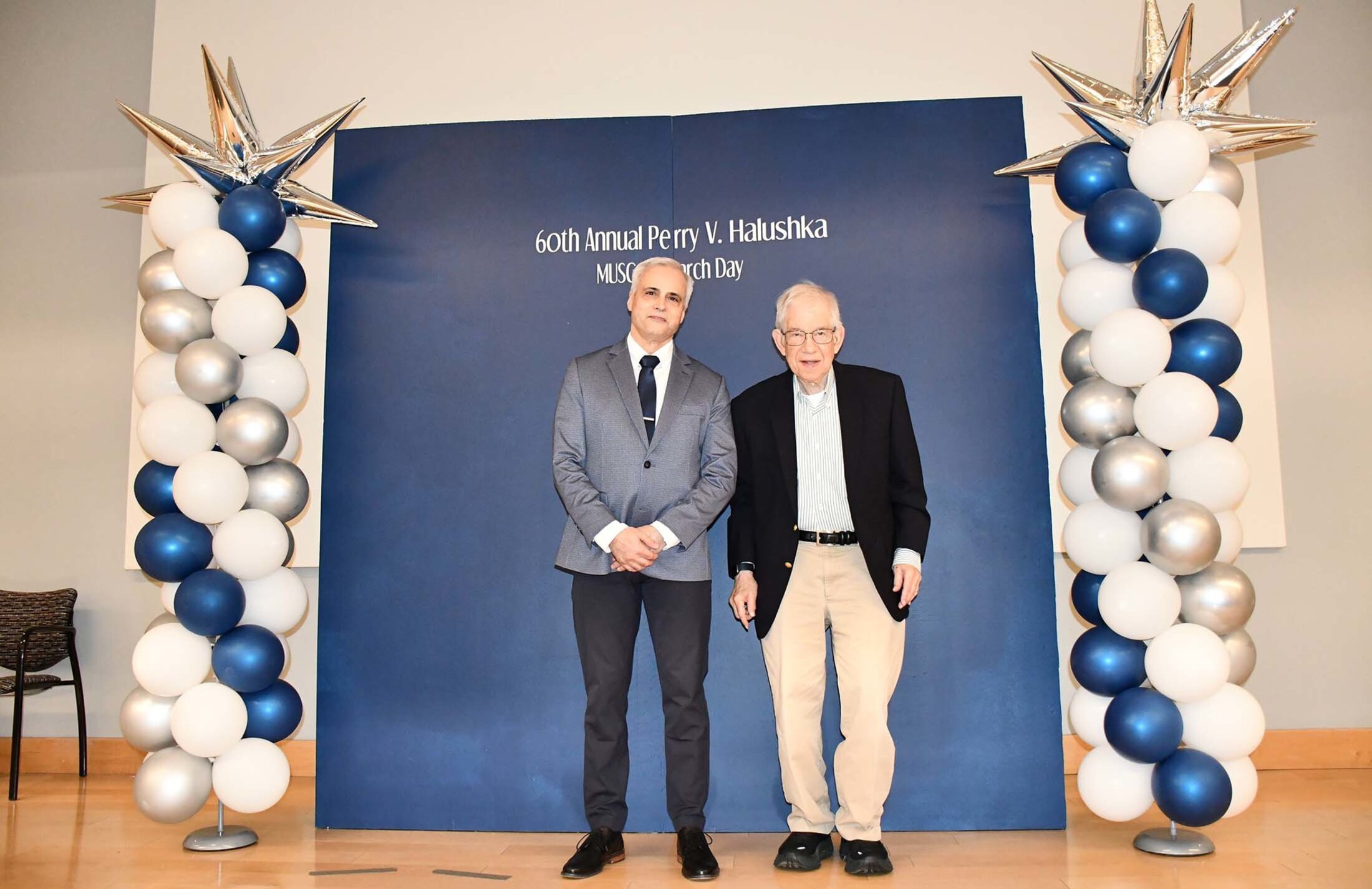
The submissions of all participants at Research Day were judged on quality, merit and scientific background. Special categories, in addition to those won by Singh and Kelly, included the Excellence Beyond Boundaries Award, the Health Humanities Award, the Interprofessional Award, the Sigma Xi Award and the John Vournakis Innovation Award. You can read more about those categories here and see the full list of awardees here.