
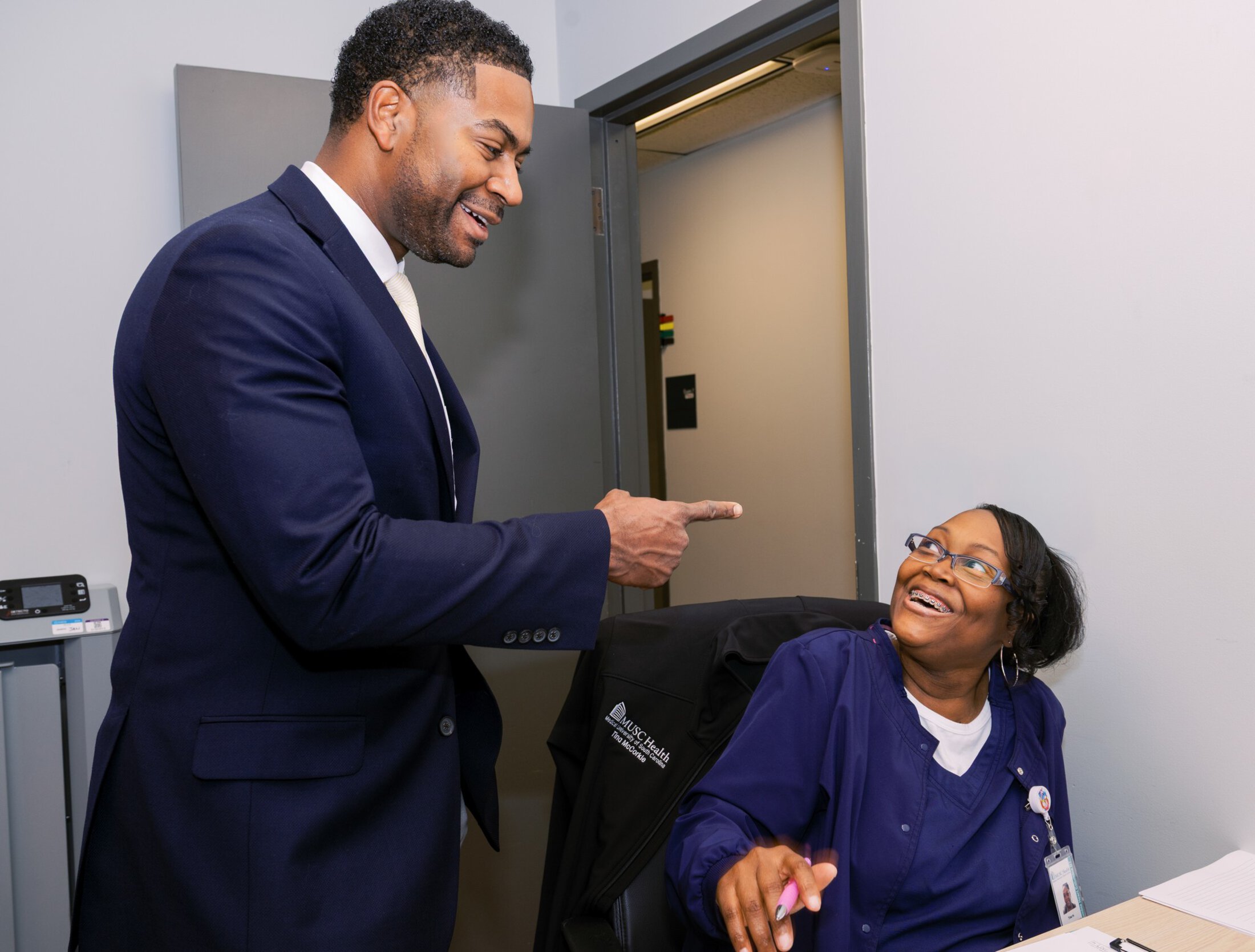
When medical assistant Tina McCorkle talks with heart failure patients at MUSC Health Heart and Vascular in Columbia, she brings more than her training to the conversations. She’s a heart failure survivor who recently celebrated the first anniversary of her lifesaving heart transplant.
“I have some cards now to give patients when they want my number so we can talk more,” McCorkle said. “On the card is the quote that got me through everything. It says, ‘You never know how strong you are until being strong is the only choice you have.’”
Strength is something McCorkle knows a lot about. Physical strength – enduring years of ailments that included a tumor in her head and congestive heart failure. Emotional strength – finding ways to keep going in the face of problem after problem. Spiritual strength – believing God has a purpose for everything.
The first signs of trouble
McCorkle was a traveling medical assistant when the first signs of trouble appeared about a decade ago. “It started with headaches. I would get a lot of headaches. I was going from hospital to hospital trying to figure out what was wrong.”
She had periods where she lost her vision, too. McCorkle said doctors treated her with high doses of steroids. That would lead to another problem, one that wouldn’t become apparent until later.
Somehow, she kept working and taking care of her family.
Pieces of the puzzle
Then, one of her doctors put the pieces of the puzzle together, recognizing that her symptoms were signs of a tumor called a meningioma. That type of tumor grows in the layers of tissue that cover the brain and spinal cord. It usually isn’t cancerous but can cause not only the kind of symptoms McCorkle had but also seizures, trouble walking, loss of smell and more. She started radiation to shrink the size of the tumor.
Soon after came another diagnosis, even more devastating. McCorkle’s heart was failing. It was due, she believes, to the high volume of steroids she’d received. “I ended up in the hospital for cardiac respiratory failure.”
The LVAD
She almost died but survived with the help of a left ventricular assist device, or LVAD, a mechanical pump that helped her heart beat for several more years.
McCorkle finally got a heart transplant at MUSC Health in Charleston, which is U.S. News & World Report's top program in the state. Surgeon Arman Kilic, M.D., chief of the Division of Cardiothoracic Surgery in the Medical University of South Carolina’s College of Medicine, performed the operation.
“A heart transplant can be life-changing for many reasons,” he said. “One is that survival improves. Right now, half of patients are living over 15 years after a heart transplant. The quality of life also improves. Patients who were struggling, barely able to get around – you give them a heart transplant, and they're basically restored to normal human life. Not just survival, but the activities of daily living. That's what is really amazing to think about.”
What she always wanted to do
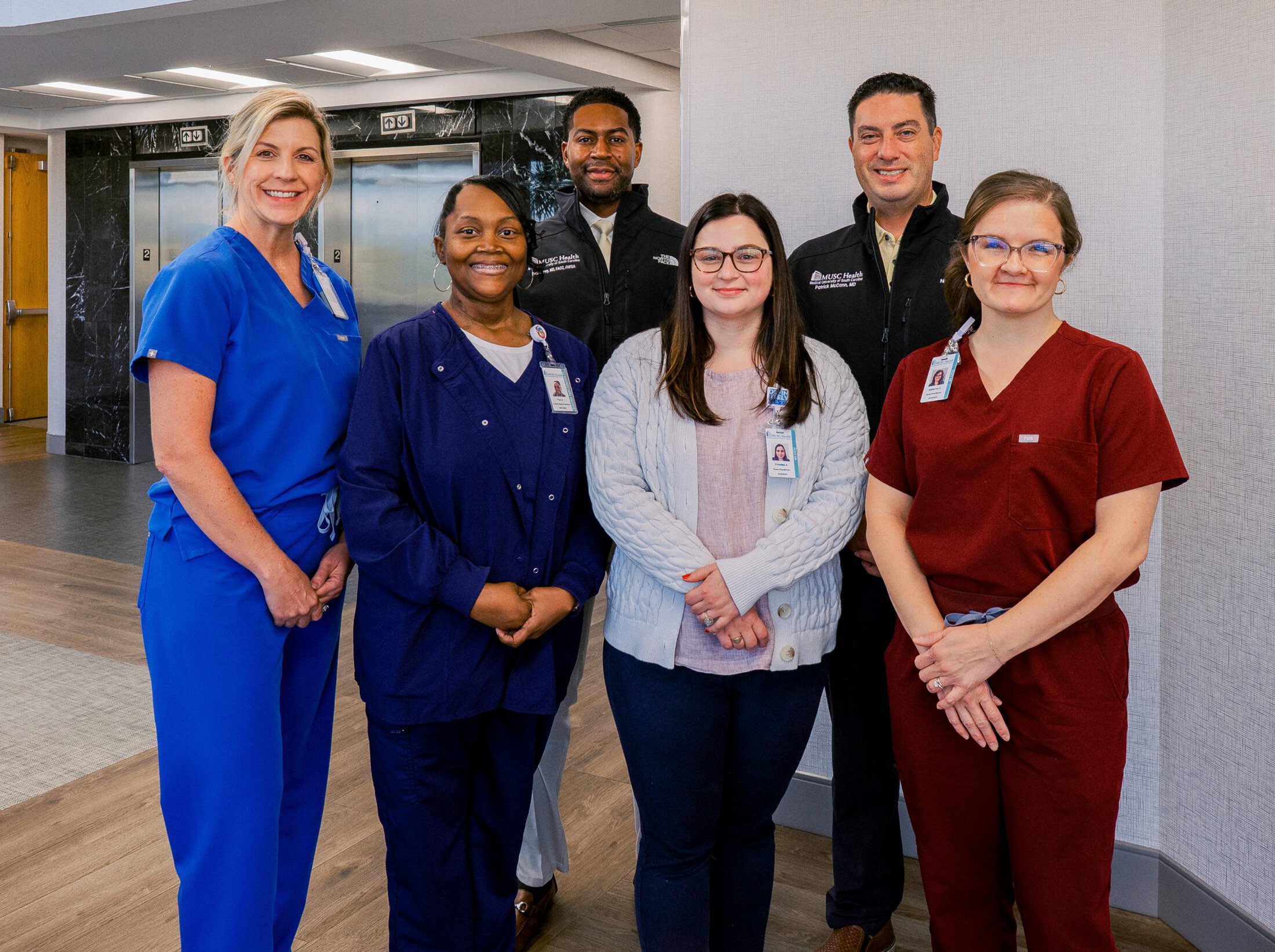
McCorkle is a living example of the power of that procedure – an example that brings hope to others living with heart problems. She took a job at MUSC Health Heart and Vascular in Columbia. “It was always what I wanted to do,” she said.
There, she works with Joshua Coney, M.D., and Patrick McCann, M.D., taking care of their patients. McCann said her presence attests to her strength and courage in the face of significant adversity. “It is also a reminder of the outstanding capability of the heart failure/LVAD program at MUSC. Working together with patients, we achieve excellent outcomes,” he said.
McCorkle loves helping those patients – people often facing the same challenges she has overcome. “I'm advocating for other transplant patients. Whenever they need me to talk to a patient, I'll talk to them,” she said.
“It is absolutely great,” she said of her post-transplant life.
Helen Adams
Recent Heart & Vascular Care stories