

Some 10 million people in the U.S. have oral premalignant disease: a group of diseases that show up as red patches, white patches or rough patches in the mouth and that might – or might not – develop into cancer.
Perhaps 7% to 10% of these cases will develop into cancer. For dentists and doctors who are monitoring these patients, the question is: Who is most likely to develop cancer and, therefore, would benefit from more intervention?
Dauren Adilbay, M.D., Ph.D., is trying to address this question through a new research project funded by MUSC Hollings Cancer Center.
Adilbay is a head and neck cancer surgeon with a specialized focus on microvascular reconstruction and thyroid surgery. He also conducts research and has done work using fluorescing compounds to illuminate problem areas, cancer and nerves.
His new project seeks to attach fluorescing dye to proteins that have already been identified as biomarkers of oral cancer and then see how these dyes show up in human tissue. Eventually, if the idea works, a dentist could give the dye, either as an injection or an oral swish, to a patient with leukoplakia or other oral premalignant disease, then use a special camera to see if the dye had accumulated in a specific spot. That would indicate that that area has a high potential to turn into cancer and should be treated more aggressively.
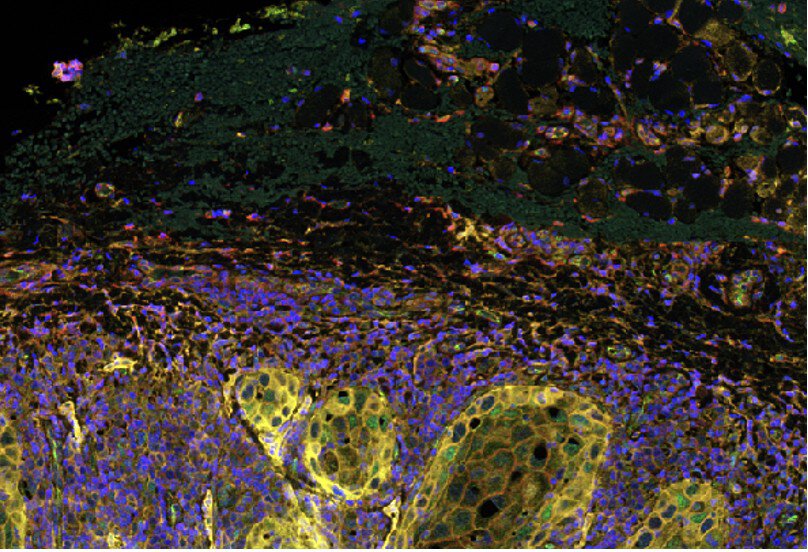
An image of oral epithelium, the tissue that lines the mouth, with dysplasia. Each color represents the expression of different markers. In the future, based on the intensity of different fluorescent colors, doctors could be able to predict if a particular lesion has a high or low risk of turning into cancer. Image provided.
Hollings funded Adilbay’s project through its Idea Award, which supports early-stage, high-risk-high-reward research. Providing funding for promising but untested ideas gives researchers the opportunity to develop their concepts and generate results that could then be presented to large external funders as proof that the idea has merit and should be explored further.
Adilbay said the current model for people with oral premalignant disease isn’t working.
“Usually we either monitor them or we treat more aggressively, with laser ablation, cryoablation or surgery,” he said. “But really, none of these have proved that they are helping.”
A number of clinical trials have tried to determine the best course of action, using treatments ranging from vitamin E to metformin, a Type 2 diabetes medication.
“They're trying to use a lot of different things to give patients orally to treat those premalignant lesions before they turn into a cancer. Unfortunately, at least at this point, none of them have been successful,” he said.
One clinical trial that does look promising is using the immunotherapy drug nivolumab. But nivolumab can cause side effects, particularly digestive system problems, lung and liver damage. For most people, the side effects are a tolerable trade-off for treating cancer or preventing a cancer that’s highly likely to develop. If doctors don’t know the likelihood that someone will develop cancer, though, the balance of that trade-off shifts.
“Giving them that type of aggressive therapy might be too much,” Adilbay said.
Other parts of the body also have mucosal linings that can develop cancers. If Adilbay’s project proves feasible, then it could potentially move on to fluoresce premalignant lesions in the colon or bronchial lining that are highly likely to become cancer.
Leslie Cantu
Senior Communications Manager
Leslie Cantu is the senior communications manager at MUSC Hollings Cancer Center, where she works with researchers, clinicians and patients to tell the people of South Carolina about the innovative work being done to improve cancer care for everyone in the state. She joined the MUSC Office of Communications and Marketing in 2018 after a career as an award-winning writer, editor and producer at community newspapers and local TV news. She transferred to the communications office at Hollings in 2022, where she happily finds something new and interesting to write about every day. Her favorite stories to cover at MUSC have included Match Day, the Angel Tree Parade, a clinical trial of CAR-T cell therapy and the many patients who have agreed to share their very personal struggles and triumphs.
Contact Leslie at cantul@musc.edu.
Recent Cancer Research stories