

It’s that time of year: New resolutions begin to sag, tax forms pile up, and it seems everyone has a fever, cough or chills.
Welcome to the height of respiratory viral season, formerly known as flu season. The name has changed because, in addition to flu, cases of RSV, or respiratory syncytial virus, and COVID cases spike this time of year, spreading through communities and posing a triple threat.
Although flu and RSV cases usually subside around late March, COVID has become a year-round menace.
These three viruses aren’t the only viruses in communities. In fact, hundreds of respiratory viruses are circulating every year at this time. At MUSC Health, we test for flu, RSV and COVID because they’re the bugs that tend to spread and land young and old alike in the hospital.
How We Protect Patients
To protect our patients and care team members against these viruses, we also closely measure and monitor the number of cases and follow those results in our clinics, inpatient areas and emergency departments across our health system. Daily monitoring allows us to make safety recommendations to our team members in our hospitals and clinics.
And, depending on the number of cases, we adjust our recommendations accordingly to help ensure that our patients and care team members are safe while still allowing visitors to be a part of their loved ones’ care.
To prevent the spread of these illnesses, we have adopted a three-pronged approach:
Each entrance to our hospitals and clinics has a caddy containing masks, gloves, and hand sanitizer. Although the caddies are placed near doors year-round, we emphasize the importance of hand hygiene and masking in our facilities when respiratory viruses are circulating. We also make sure these items are available in all patient areas.
Three Ways We Prevent the Spread of Viruses
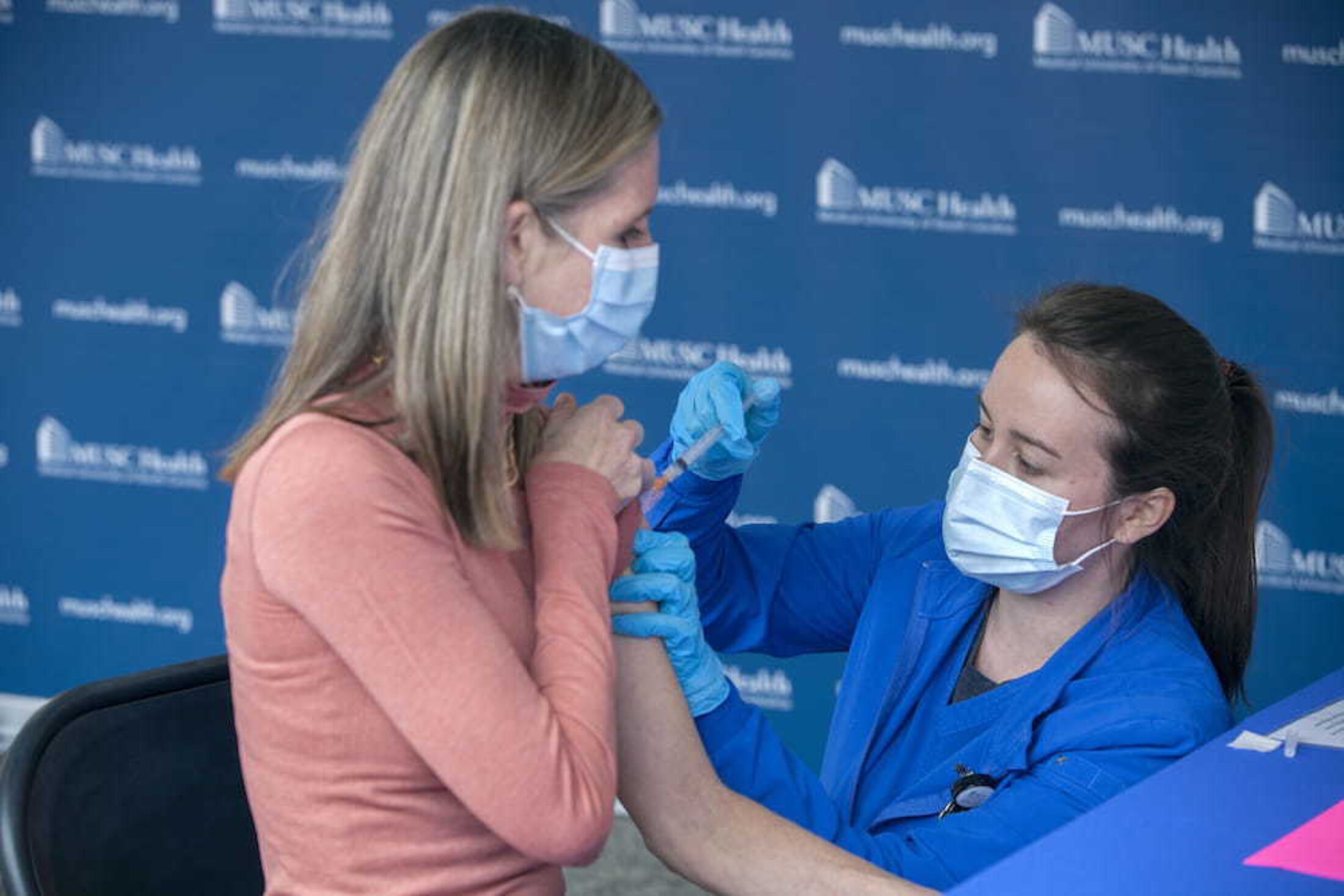
- Vaccines. Get vaccinated and stay up to date on your vaccines. COVID and RSV vaccines are available throughout the year. Flu vaccines are available in fall and winter – enough time to provide immunity against these illnesses or at least diminish their side effects if you get sick. MUSC Health strongly recommends these 3 vaccines for eligible individuals.
- Masking. Masking during respiratory viral season works and is a common-sense, effective method to reduce the spread and transmission of respiratory viruses by “source control.” You’re less likely to get sick or to spread a respiratory virus if you’re wearing a mask.
- Voluntarily Restrict Visitation. We encourage care team members, family members and visitors to avoid coming to our health care facilities if they’re sick or experiencing symptoms of illness. If you’re ill and have a family member who must come to one of our facilities, please stay home so we can protect our patients and care team members.
Sometimes, we’re asked about restricting visitation. Here’s what we say: At MUSC, we’re passionate about the benefit of having family members accompany patients in all care settings whenever possible.
Our guiding principle is to not restrict access to patients because we understand the comfort of a family member’s presence at the bedside. The benefit of having a family member present outweighs the potential downside of spreading viruses in most cases. COVID showed us the vital nature of having a family member present with the patient and how it benefits not only the patient but also helps our care team take better care of the patient.
We’re dedicated to remaining patient- and family-focused. With your help – getting vaccinated if eligible, practicing good hand hygiene, masking up and voluntarily staying away when sick — we can weather the respiratory season together.
Worried you’ve caught a virus?
Make an appointment with a primary care provider. Both virtual and in-person appointments are available!

Danielle Scheurer
Chief Quality Officer, MUSC Health Professor, Hospital Medicine
Danielle Scheurer, MD, MSCR is an adult Hospitalist physician, Professor of Medicine, and System Chief Quality Officer at the Medical University of South Carolina (MUSC) Health System. She completed undergraduate studies at Emory University, medical school at The University of Tennessee, and Medicine-Pediatrics residency training at Duke University. She then joined MUSC as a Hospitalist, and completed her Masters in Clinical Research. She then practiced as a Hospitalist and Medical Director of the Inpatient Medicine Services at Brigham and Women’s Hospital in Boston for 5 years, before returning back to MUSC in 2010. She is also a certified trainer in Just Culture and TeamStepps, is a Lean-Six Sigma Black Belt, a Baldrige National Examiner, and a certified mediator.
As System Chief Quality Officer, she oversees all Quality-Safety, Regulatory, Population Health, and Value-Based Payment models for the system. She is passionate about instilling High Reliability principles throughout the healthcare system, to improve safety and quality across all sites for all patients, while simultaneously enabling team engagement for performance excellence.
Recent Advance with MUSC Health stories