
Health care workers want to provide culturally sensitive care. But understanding what that looks like in the midst of an ongoing public health crisis, like the opioid epidemic, can be difficult to envision.
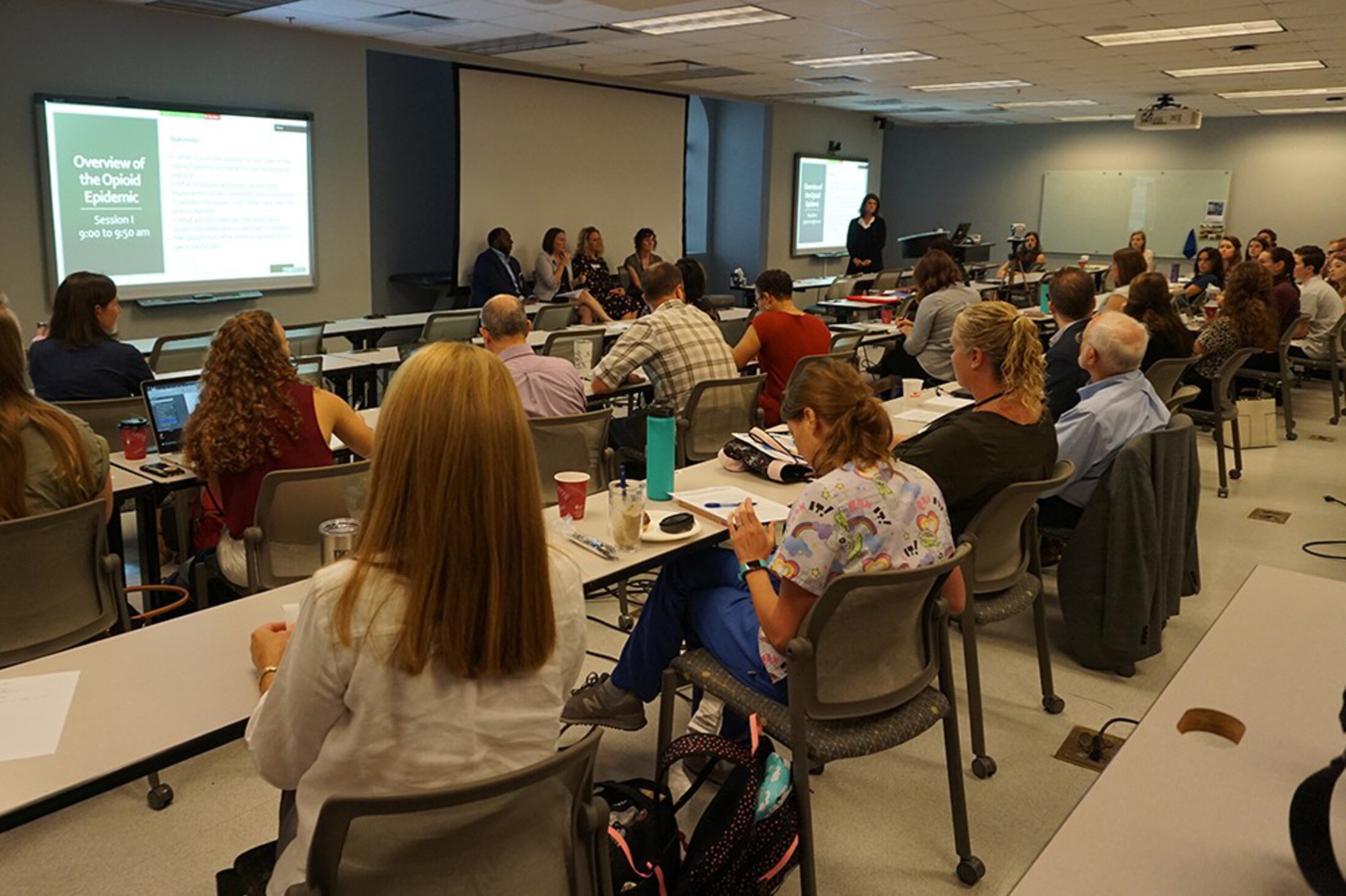
While addressing a group of interprofessional students, faculty and staff on campus, a panel of opioid use survivors shared their stories. Occupational therapy student Nicholas Dean said it was heartbreaking to hear how poorly some of them have been treated by various health care providers.
“It was a reminder of how easy it is for health care professionals to forget the compassion that brought us into health care in the first place,” he said.
The panelists spoke as part of a workshop developed by Cristina Reyes Smith, OTD, an assistant professor in the College of Health Professions Division of Occupational Therapy, and the Culturally Sensitive Care Series planning committee. The workshop sought to illuminate a real-world application of culturally sensitive care in the context of the opioid epidemic.
MUSC Health strives to follow the National Standards for Culturally and Linguistically Appropriate Services in Health and Health Care (the National CLAS Standards) published by the U.S. Department of Health and Human Services, which outline how health care organizations should strive to provide services responsive to diverse health beliefs and practices, languages and health literacy.
Kathleen White, program director for patient and family education, said the workshop allowed for a mingling of people focused on the National CLAS Standards with people focused on the opioid epidemic.
“It was a really rich exchange of ideas,” she said.
They realized that some of the technology that MUSC Health uses now to meet the National CLAS Standards could also be used to address opioid overuse in a sensitive manner. For example, MUSC’s GetWellNetwork provides patient education videos in patient rooms in both English and Spanish and includes a menu of choices that might aid in their recoveries. Patients can watch relaxation videos or schedule a visit from a pet therapy dog, a volunteer companion or a chaplain – activities that can help a person cope with pain without using medication.
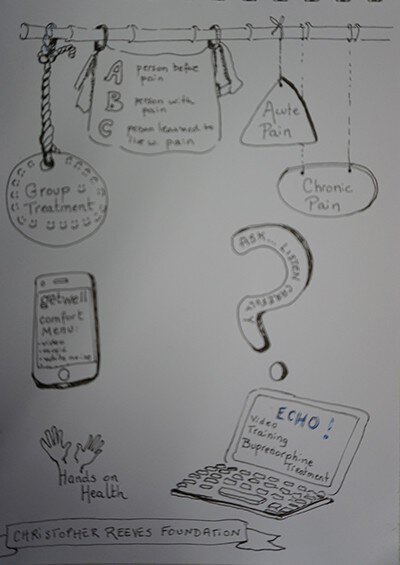
Smith believes it’s important for the next generation of health care providers to be trained with this concept in mind. To that end, MUSC students in an interprofessional course took part in the one-day workshop, then implemented the ideas generated that day by visiting patient rooms on post-surgical units to walk patients through available resources. Smith tasked the students with observing and considering each patient’s social determinants of health. For example, did they have a support person with them? Would they have support upon discharge?
Dean said two particular patients, one of whom he met in the hospital and the other in the student-run CARES Clinic, stood out to him. On the surface, the men shared many characteristics, he said. Both were middle-aged white natives of South Carolina. But the patient in the hospital was surrounded by family and excited about returning to work; his boss was holding his job for him.
Conversely, the patient at the clinic arrived already at odds with clinic staff, probably due to past experiences in health care settings, Dean said. He didn’t have a job, had little in the way of a support system and was evasive when asked if he had a place to stay. It was clear that the man in the hospital had the social supports and extrinsic motivations that would make it easier to avoid falling into opioid addiction, Dean said.
This compelled Dean, he said, to reflect seriously on what he observed both at the workshop and during his time with patients, so as to consider how he could play an active role in addressing such disparities once he begins his career.
The students also were able to introduce patients to the many options available in the GetWellNetwork, especially those that pertained to special health situations. The network offers information that explains not only the necessity of prescribing opioids appropriately for specific medical conditions but also the dangers of these drugs.
Nursing student Kim Tuemler said that she found each patient responded to a different option on the network. One woman was entranced by sunset videos, while another was excited to learn she could watch sermons. One man was happy to be able to play pink noise.
Tuemler has already accepted a job as an operating room nurse at MUSC, and she said she’ll tell her patients about the GetWellNetwork options. “I’m very enthusiastic about it,” she said.
White noted that the hospital exercise pushed some students outside their comfort zones, particularly the students who didn’t have experience entering patient rooms.
“Because it’s awkward,” White said. “You never go up to somebody and say ‘Are you dealing well with pain? What coping skills are you using, and are they healthy or unhealthy?’ You just don’t do that. So just learning how to initiate those conversations was really good practice for these students.”
Dean was excited about the workshop because he wanted to be part of the conversation about opioids. Occupational therapy has a lot to offer in terms of pain management and ways to address the opioid epidemic, he said.
By the same token, community health leaders who work in drug recovery organizations got a chance at the workshop to consider whether they’re doing everything possible to reach people in diverse communities who need their help. “You could see their wheels turning,” Smith said.
As MUSC prepares for the opening of the MUSC Shawn Jenkins Children’s Hospital and Pearl Tourville Women’s Pavilion, Smith is excited about how White’s team is harnessing technology to provide culturally sensitive communication to all patients. Smith and her children even got to be a part of the new GetWellNetwork welcome videos in Spanish.
“For me to know that MUSC has had that level of commitment to diversity, equity and inclusion that is manifesting in the new Shawn Jenkins Children’s Hospital really means a lot,” Smith said. “I grew up in this community. I’ve been here since I was 3 ½ years old, 25 minutes up the road in Hanahan and Goose Creek. I’ve known a lot of people who’ve accessed care here at MUSC, both English speakers and Spanish speakers alike. The facility is just gorgeous, but to know diversity, equity and inclusion is such an important part from the ground up – I can’t describe how meaningful it is to me.”
Leslie Cantu
Senior Communications Manager
Leslie Cantu is the senior communications manager at MUSC Hollings Cancer Center, where she works with researchers, clinicians and patients to tell the people of South Carolina about the innovative work being done to improve cancer care for everyone in the state. She joined the MUSC Office of Communications and Marketing in 2018 after a career as an award-winning writer, editor and producer at community newspapers and local TV news. She transferred to the communications office at Hollings in 2022, where she happily finds something new and interesting to write about every day. Her favorite stories to cover at MUSC have included Match Day, the Angel Tree Parade, a clinical trial of CAR-T cell therapy and the many patients who have agreed to share their very personal struggles and triumphs.