
Editor's Note: Chief of Police Luther Reynolds passed away May 22, 2023. We at MUSC Hollings Cancer Center extend our sympathies to his family, friends, police family, and all those who drew inspiration from his story.
Tears come to the eyes of Luther Reynolds more easily now. But he’s OK with that. Cancer, the kind of battle he has had to fight, will do that to a person. The tears are a badge of honor for the City of Charleston chief of police, who is known for his grit and determination as well as his kind heart and generosity.
He’s been through the wringer since his diagnosis with sarcoma in October of last year. Sarcoma is a type of cancer that begins in bone or in the soft tissues of the body. To make matters worse, Reynolds has a rare form called a triton tumor, maybe one of 100 such tumors ever reported. It’s a cancer that would end up taking his right leg, part of his hip and sacrum.
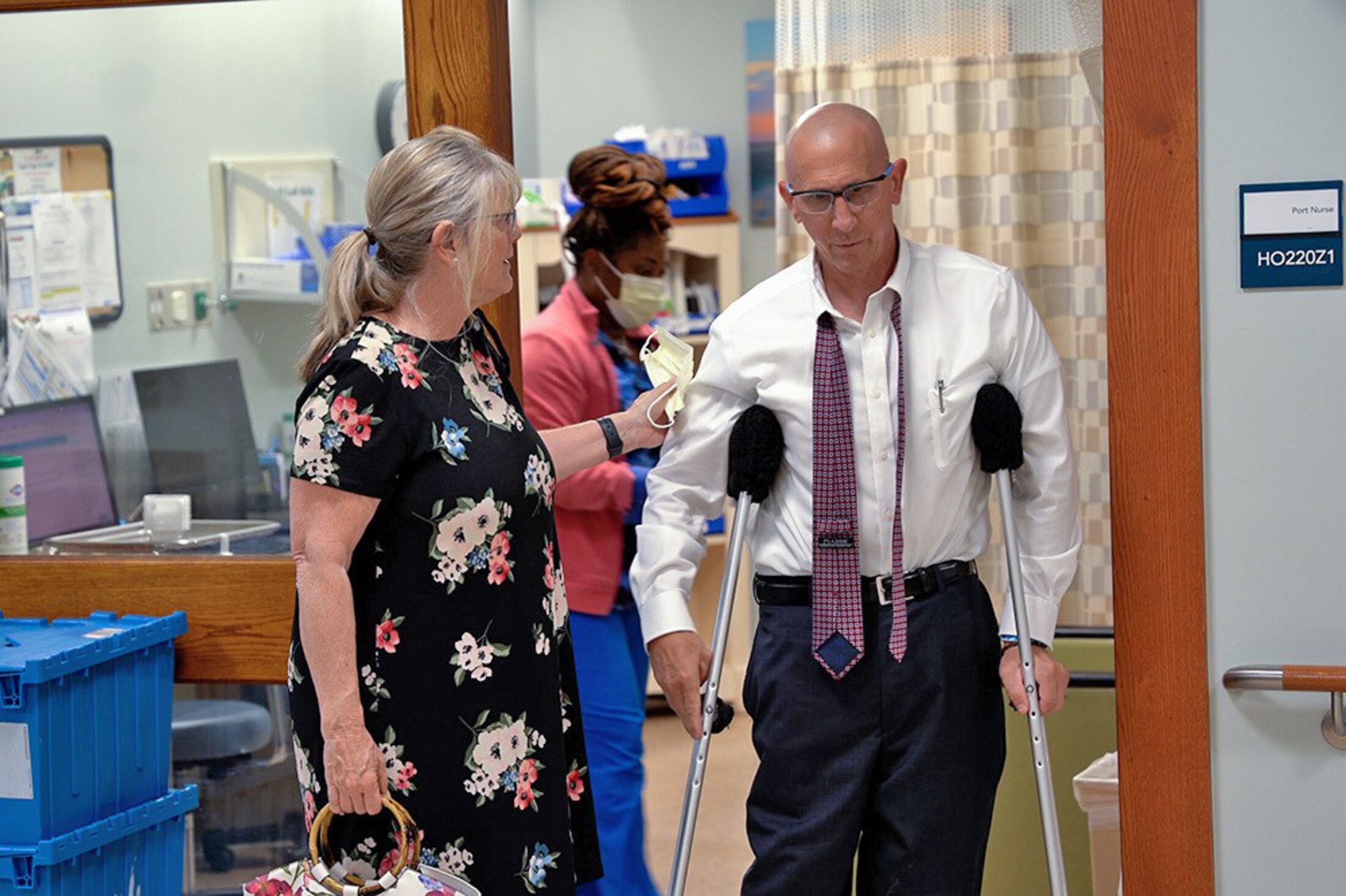
It’s a hot day, and Reynolds, outfitted with a state-of-the-art prosthetic leg, has driven himself in his modified vehicle to MUSC Hollings Cancer Center and navigated getting to the third floor. His days of pushing himself hard in rehab are evident as he maneuvers much better down the hallway than he was able to do just a month ago.
Reynolds is here to film a Hollings Cross Talk interview that will air this month for Sarcoma Awareness Month. Since his diagnosis, the 55-year-old police chief takes time to do advocacy work for other cancer survivors despite his already packed schedule, leading the city’s more than 450-member police force during a turbulent time in the nation’s history.
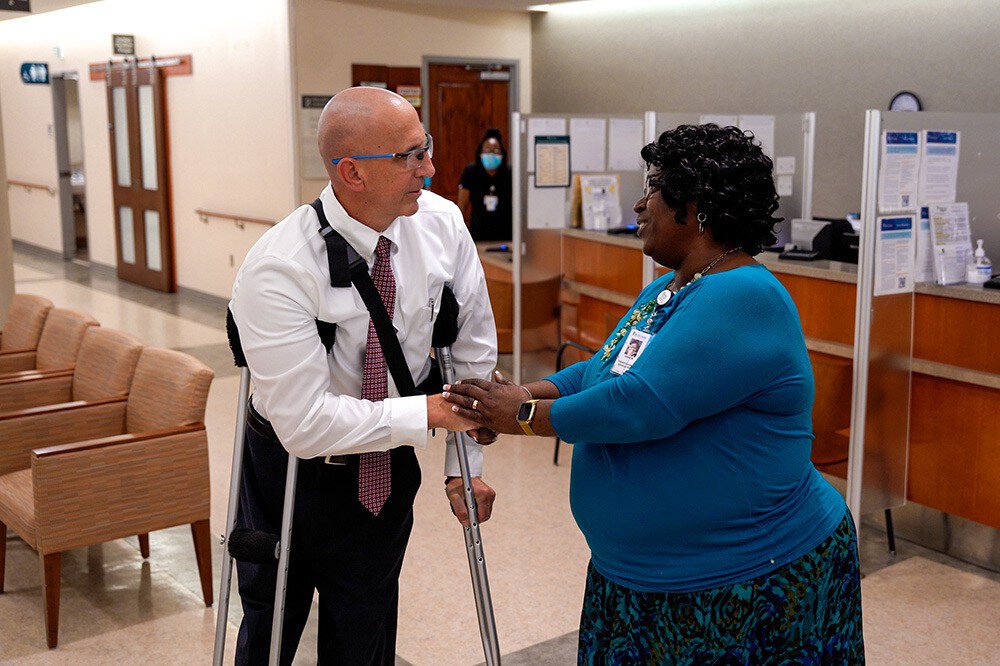
Chief Reynolds greets Dawn Morgan, a patient access representative, at Hollings. Photo by Clif Rhodes
He’s here to be vulnerable and tell others it’s tough — but they aren’t alone in the struggle. He’s here to say pay close attention to pain that doesn’t go away, such as the back pain he had that finally led him to a doctor and a diagnosis he never expected. He’s here to say there needs to be more funding for cancer research, including for rare forms, and how essential it is for survivors to reach out for the support they need.
It’s not just lip service for the chief, who always has prided himself on an active lifestyle that included running marathons and even ultramarathons. He now looks down at his prosthetic to talk of the phantom pains he has. The former college rugby player has reason to be angry and resentful, but that is not what comes out. Instead, he talks of drawing from his faith and what this season of life is teaching him. He talks about the love story that’s playing out in his life because of this journey.
There have been the hundreds of cards and calls, standing ovations, chalk drawings on the sidewalk outside his home to welcome him home from his surgery, prayers from family and friends and his men’s church group at Seacoast and even well wishes from strangers. He’s humbled and strengthened, overwhelmed by the blessings and feels compelled to give back.
“I really believe that God has more work for me to do. Now, instead of two legs, I just got to figure out how to do it with one.”
Inspirational icon
It’s 8:30 a.m. on Daniel Island, and Reynolds is breaking a sweat on the treadmill during his rehabilitation session. Sgt. Elizabeth Wolfsen, public information officer with the City of Charleston Police Department, jokes with him as he edges up to 3.2 miles per hour, perfecting a kicking motion with his hip to propel his prosthetic leg forward.
“I thought you were going to break out in a run,” she said, smiling. “You were cruising along.”
Next Reynolds tackles the staircase with his therapist, going up and down the steps. This is followed by standing one-legged weight work and then, just when most people would be collapsing, Reynolds begins doing a series of burpees.