
For thousands of South Carolinians living with a rare disease, hope is growing. That hope is driven by steady momentum from MUSC’s Rare Disease Advisory Council (RDAC), a statewide group, implemented by the Governor’s office, working to improve care, awareness and coordination.
Rare diseases affect about 30 million Americans, including many families in South Carolina. Individually, these conditions are uncommon, but together, they touch nearly every community in the state. For patients and families, the journey often includes delayed diagnoses, limited treatment options and difficulty finding knowledgeable care.
The SC RDAC was created to address these challenges. By bringing together patients, caregivers, clinicians, researchers and advocates, the council works to strengthen connections and elevate shared priorities across South Carolina. The SC RDAC is one of nearly 30 RDACs across the nation, stemming from the National Organization of Rare Disorders’ Project RDAC initiative that launched in 2020.
South Carolina’s council is uniquely housed within the South Carolina Clinical & Translational Research (SCTR) Institute. Being anchored in SCTR has allowed the RDAC to grow quickly and turn ideas into action. SCTR provides the infrastructure needed to support research, community engagement and statewide coordination. With this strong foundation, the RDAC has been able to launch initiatives, share public resources and respond to community needs in a meaningful way.
With support from leadership, including Patrick Flume, M.D., Distinguished Professor of Medicine and Pediatrics at MUSC and the Powers-Huggins Endowed Chair for Cystic Fibrosis, and Neena Champaigne, M.D., division chief, Medical Genetics and Genomics, SCTR staff members Tara Pittman, research recruitment manager, and Kimberly Brown, community engagement and rare disease program manager, play key roles in guiding this work. Together, they coordinate efforts, support council members and ensure that community voices remain central.
We aim to be a resource for the rare disease community.
Building momentum through collaboration
A major source of the RDAC’s momentum comes from collaboration. By connecting with partners both within and beyond South Carolina, the council has strengthened its voice and expanded its reach.
National engagement has played an important role in this growth. In 2025, RDAC leaders, members and staff took part in several national rare disease meetings and events. According to Pittman and Brown, the most impactful was the annual RDAC members meeting, where they were able to network with others from across the nation to share resources, brainstorm solutions to common productivity barriers and come up with opportunities for collaboration. Brown also presented a scientific poster at the fall Clinical and Translational Science Awards (CTSA) program meeting in Washington, D.C., where faculty, staff and leadership from other CTSA hubs, like SCTR, met to exchange ideas and updates and learn from one another. Her poster highlighted the value of embedding a rare disease council within a research department infrastructure like SCTR.
The result of this year of engagement and collaboration has been increased visibility and renewed energy. The council has been able to share new tools, including its website and public-facing resources, with a broader audience. “These events gave us the chance to say: We’re here. We’re working. And we’re committed to making an impact for rare disease families in South Carolina,” said Pittman.
Just as important, national collaboration has reinforced the RDAC’s local mission. Ideas gained from these connections continue to shape how the council supports patients, families and professionals across the state.
These events gave us the chance to say: We’re here. We’re working. And we’re committed to making an impact for rare disease families in South Carolina.
Building momentum by listening to the community
Momentum is also built by listening. The RDAC places strong value on hearing directly from those most affected by rare diseases. Each year, the council creates space for patients, caregivers, clinicians, researchers and advocates to share experiences and priorities. These conversations help to guide the council’s work and ensure that its leaders remain responsive to real needs.
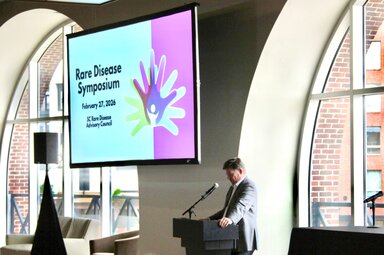
A key example is the annual Rare Disease Symposium. On Feb. 27, the RDAC will host this statewide event in Columbia, with a virtual option to ensure broad access. The symposium is designed to be inclusive and easy to understand. Sessions are structured so that people without a science background can fully participate and learn alongside professionals.
“We aim to be a resource for the rare disease community,” explained Flume. “At the annual symposium, we try to share some novel research being performed in South Carolina as well as shine a light on the various ways that the community can advocate for themselves and others.”
The event brings together a wide range of stakeholders that includes patients, families, clinicians, researchers, advocates and industry partners. This mix of perspectives encourages shared learning and collaboration. By gathering a wide variety of voices in one place, the symposium helps to align priorities and spark new ideas. It also strengthens trust between the RDAC and the community it serves, reinforcing a sense of shared purpose.
Alone we are rare, but together, we are strong. That’s not just a slogan – it’s the blueprint for how we create meaningful change.
Sustaining progress for the future
With growing engagement and visibility, the RDAC is focused on sustaining its progress. Leaders are working to ensure that momentum continues well beyond individual events or initiatives. One long-term goal is to support a more member-led council. Over time, council members are expected to take on greater roles in shaping priorities and guiding new efforts.
“My hope is that this recent engagement is just the starting point,” said Brown. “It’s opening doors to more partnerships and a stronger rare disease network across South Carolina.”
At its core, the RDAC remains focused on challenges shared across the rare disease community – from delayed diagnoses, fewer treatment options and limited access to expert care to persistent barriers to clinical trials and research participation.
By connecting people who might never otherwise meet, the RDAC helps to reduce isolation and strengthen collaboration. Patients and families gain access to information and support while researchers and clinicians gain insight from lived experience.
This shared approach reflects the council’s guiding belief that progress happens faster when people work together. “Alone we are rare, but together, we are strong,” said Brown, repeating the National Organization for Rare Disorders’ motto. “That’s not just a slogan – it’s the blueprint for how we create meaningful change.”
The 2026 Rare Disease Symposium will be held at Segra Park in Columbia, on Feb. 27, from 10 a.m. to 2 p.m. Registration for this free event, as well as information about quarterly meetings, which are open to the public and held virtually, can be found on the RDAC website at rarediseasesc.org
Sophia Barry Gordon
Sophia Barry Gordon is the science writing and communications program coordinator at the South Carolina Clinical & Translational Research (SCTR) Institute. She holds a Master of Science degree from New York University and is currently a Ph.D. candidate at the University of Birmingham (UK).
Recent South Carolina Rare Disease Advisory Council - RDAC stories