

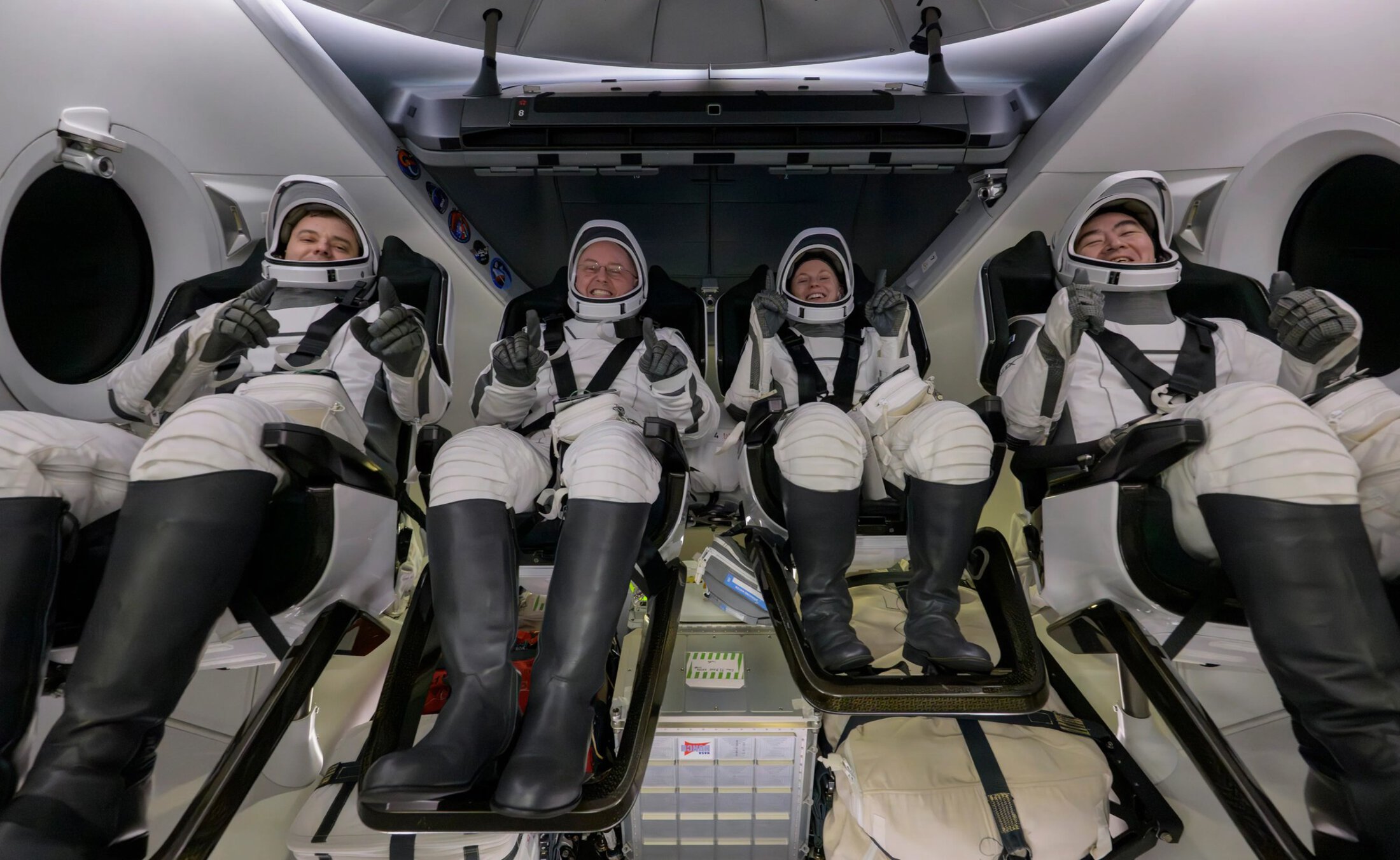
When the NASA SpaceX Crew-11 team landed this morning off the coast of San Diego, it marked the first time that astronauts returned to Earth from the International Space Station early for a health reason. NASA isn’t identifying the astronaut with the medical concern or saying what the problem is, but its administrator said all four crew members are “safe and in good spirits.”
The unprecedented event raises a lot of questions but also an important point, according to the director of the Medical University of South Carolina’s Division of Aerospace Neurology and Human Performance.
“As NASA’s chief medical officer said, ‘This is supposed to happen once every three years.’ So the fact that it hasn't happened in the space station’s 25-year history is pretty incredible,” said Mark Rosenberg, M.D.
“And I think if anything, it's a testament to the screening practices and how close the relationship is between the astronauts and the ground crew.”
But Donna Roberts, M.D., who works closely with Rosenberg and is a former deputy chief scientist of the International Space Station National Laboratory, said the landing was also a reminder of the challenges astronauts may face in the future as spaceflight becomes more common. “We really need to start thinking about how to handle these types of situations and put protocols in place. I think this is a wake-up call.”
A call to focus on prevention and emergency protocols
It’s a wake-up call that Roberts and Rosenberg have heard coming. Their recent paper in Neurological Clinical Practice, titled “Prevention of Cerebrovascular Emergencies in Spaceflight: A Review and a Proposal for Enhanced Medical Screening Guidelines,” emphasized the need for in-flight emergency management protocols, comprehensive preventive screening and evaluation of risk factors.
The key reason for their sense of urgency involves changes in space travel. For example, Rosenberg said: “A big question is what happens when the ISS goes down in 2030 and is replaced by a commercial spaceflight vehicle.”
More commercial spaceflights
More commercial spaceflights will increase the frequency with which people go into space, Rosenberg said. “But the medical criteria might not be as stringent. So people with preexisting health conditions that were previously ruled out, or potential complications of said comorbidities, might become concerns in the future. So that's a really big unknown right now.”
Roberts said spaceflights will also become longer, which will pose more challenges. “It's been pretty easy, relatively speaking, to return quickly from low-Earth orbit. But once you move to the moon and Mars, that's not really going to be an option.”
Working toward solutions and safety
They are far from the only scientists focusing on such concerns. Rosenberg said NASA has developed a risk resource roadmap. “So it's basically a stratified risk plan that looks at low-Earth orbit, lunar operations, Martian operations and beyond. And there are certain things that are not really that big of a deal for low-Earth orbit but may be somewhat of an issue for lunar, but of course, Mars and beyond.”
Scientists are also working to solve problems, such as communication delays, when space travelers far from Earth need immediate help. “There’s about a seven-minute delay for communication with somebody on Mars. And they're coming up with ways, using artificial intelligence, to help bridge that gap,” Rosenberg said.
They’re also studying how to maximize the use of any equipment that goes on the spaceflight because room is limited and so is how much weight can be carried.
And the effects of space on people’s health, apart from conditions they might already be suffering from, are being scrutinized as well. Research from the team in MUSC’s Division of Aerospace Neurology and Human Performance includes studies on spaceflight-associated neuro-ocular syndrome, also known as SANS, along with projects focused on the brains, stress and sleep patterns of astronauts.
It’s important work as spaceflight moves closer to becoming a reality for people who would never have been able to reach for the stars in the past. “That’s certainly a silver lining to it,” Rosenberg said. “Ultimately, either in the next 10, 20, 30, 40 or 50 years, everybody will be going to space or have the opportunity to go to space.
People who have already had that opportunity, including the crew that landed today, have laid the groundwork.
“With today’s landing, they announced it, and they had time to plan it out, and it wasn't an emergency condition. But if there are issues – stroke or hemorrhages and that type of thing – where you have to de-orbit quickly, there's a lot you have to take into consideration,” Roberts said.
“That's why we need to have these conversations now. Because if we act reactively, it's going to result in this either happening more frequently or more severely,” Rosenberg said.